

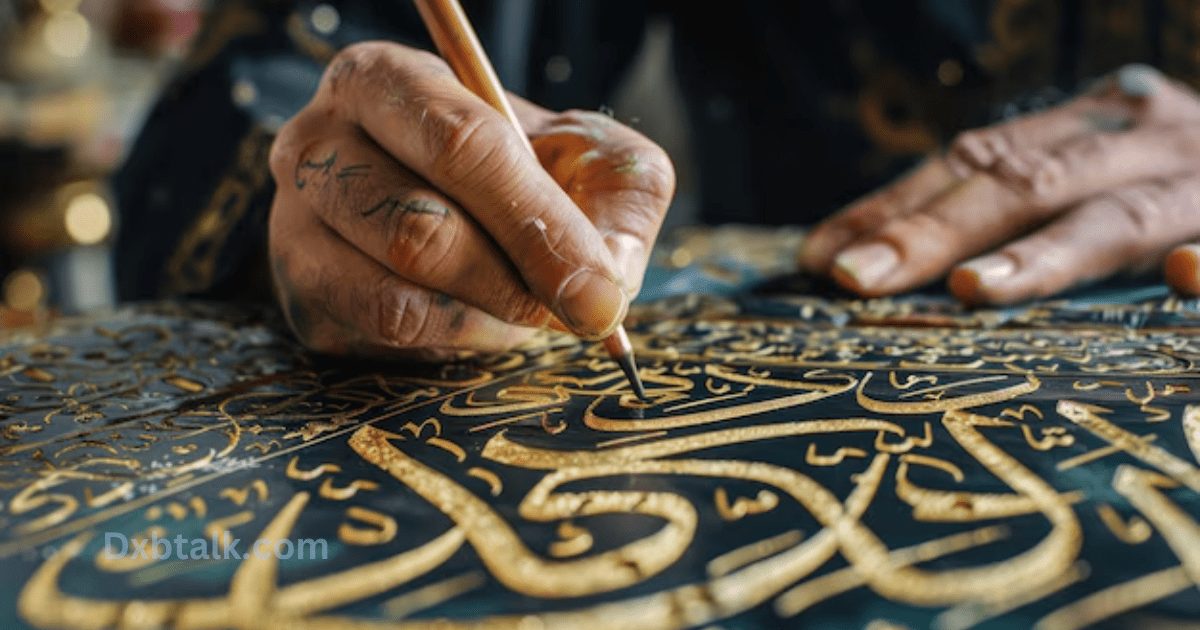
In Dubai, writing is architecture. It climbs the facade of the Museum of the Future in vast silver letters, curves across mosque walls in gold, appears on wedding invitations, hotel identities and the sides of galleries, a single art form simultaneously sacred, civic and commercial. Calligraphy holds this place because in the Arab and Islamic world it was never merely handwriting: it is the visual form of the word itself, cultivated for fourteen centuries into one of humanity’s great arts. Dubai, the city of fusion, has become one of its modern capitals.
Where You See It
Start with the landmarks. The Museum of the Future wears its calligraphy as its skin, Quranic and visionary phrases in the Thuluth script wrapping the torus in stainless steel, so that the building is literally made of writing. Mosques across the emirate carry verses in the classical manner, the calligraphy doing theological work: the word made beautiful as an act of devotion. Then notice the everyday layer: the signage of old Dubai, the branding of luxury houses that commission bespoke Arabic lettering, the murals and public art in districts like Alserkal Avenue where calligraphy escapes the page entirely and takes walls. The art is not preserved in this city. It is employed by it, everywhere, all the time.
The Scripts and the Craft
Behind the beauty stands a discipline as exacting as any in music. The classical scripts each carry a character: Kufic, angular and monumental, the script of early Qurans and stone; Naskh, clear and flowing, the workhorse of books; Thuluth, the grand ceremonial hand of mosques and landmarks, letters built like architecture. Mastery is measured in years: the reed pen cut by hand, the ink, the proportions governed by a geometry of dots and letterforms refined over centuries, traditionally learned under a master who grants an ijazah, a licence, when the student’s hand is ready. Dubai’s calligraphers work both sides of this inheritance, purists preserving the classical canon and contemporary artists bending it into digital art, murals, installations and luxury branding, arguing productively about where the line of the art runs. The argument itself is a sign of health.
📸 Follow @dxbtalk1 on Instagram for daily Dubai in photos →
Learning It, and Watching the Masters
For the resident who wants more than admiration, the city provides doors. Workshops at cultural centres such as Alserkal Avenue and the Dubai Calligraphy Centre teach the scripts to beginners, reed in hand, and a single session permanently changes how you see every sign in the city. The exhibition calendar crowns the scene: the Dubai International Calligraphy Exhibition gathers masters from around the world, whose works, classical and experimental, set the standard the local community then chases for a year. Between the workshops and the exhibitions sits a working market: bespoke wedding invitations, personalised gifts, corporate identities and commissions of every scale, an economy that keeps the art employed between masterpieces.
Why It Thrives Here
Calligraphy’s Dubai flourishing is not nostalgia. It is the meeting of a deep tradition with a city that commissions boldly, pays properly and builds at a scale where a facade can be a poem. The multicultural population adds its own scripts and lettering traditions to the conversation, and the art responds the way living arts do, by growing. In most cities, calligraphy is a heritage craft in a museum case. In Dubai it is on the newest building in the world, in letters three storeys high. Tradition and modernity is the city’s cliché; nowhere is it more literally written out.
Commissioning a Piece of Your Own
One of the scene’s quiet pleasures is that it remains hireable. Dubai’s calligraphers take commissions across the full range of occasions: a name rendered as a gift, a verse prepared for a home, wedding stationery that turns an invitation into an heirloom, a wordmark for a business that wants its Arabic identity designed rather than typed. Briefing a calligrapher is a conversation worth having in person where possible: the script that suits the words, the style that suits the wall or the page, the difference between a classical composition and a contemporary one. Prices follow the master’s reputation and the work’s scale, and the result, in a city of printed everything, has the rarity of the handmade. Hang it well. You will be asked about it for years.



Join the conversation