

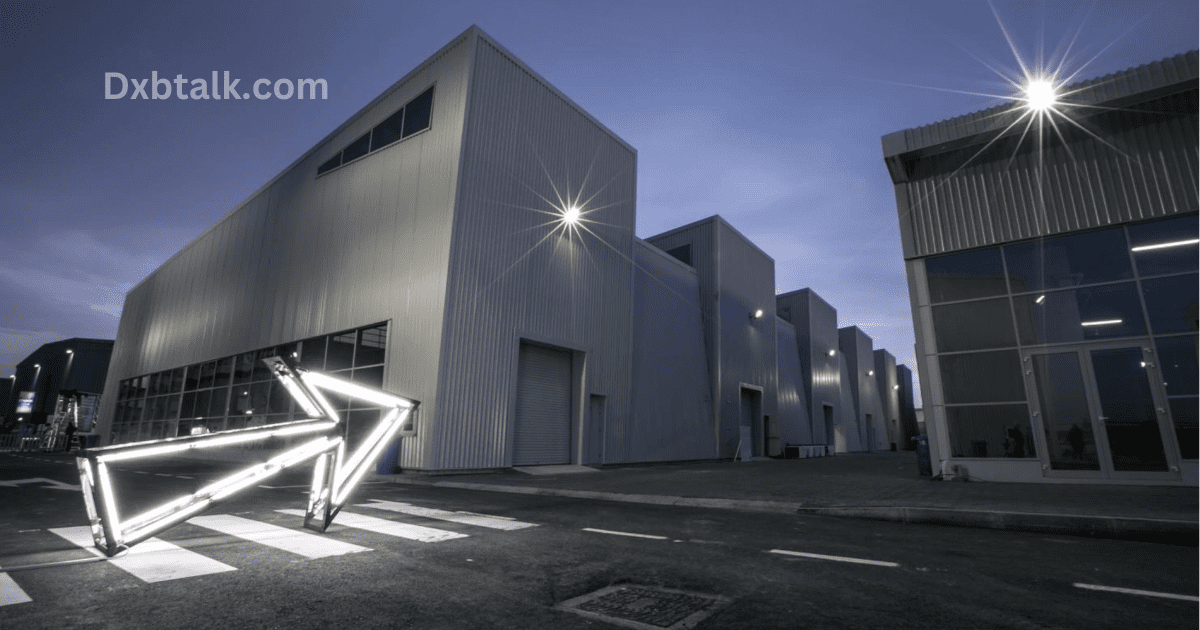
Every interesting city district has a before-picture, and Al Quoz’s is unusually stark: a grid of sand-coloured warehouses and factories on Dubai’s industrial flank, given over to marble works, garages, storage and light manufacturing — a place you drove through, never to. Today the same grid holds the city’s contemporary art scene, its specialty coffee roasters, design studios and climbing gyms. The style that fused those two lives together has a name — industrial chic — and Al Quoz is where Dubai learned it.
The Shift from Industrial to Artistic
The transformation began with a simple economic fact: artists and galleries need large, cheap, flexible space, and warehouses are exactly that. Through the 2000s, former industrial units were repurposed one by one into galleries, studios and creative hubs — high ceilings that take monumental canvases, loading bays that take monumental sculptures, rents that (at first) took pity on monumental ambitions. Alserkal Avenue’s conversion of a marble factory into a cultural district gave the shift its flagship, and a creative community formed that now challenges every assumption about where culture in Dubai is supposed to happen — not in a marble-clad institution, but behind a roller shutter.
What Industrial Chic Actually Looks Like
The aesthetic is the honest retention of the working shell. Polished concrete floors that were poured for forklifts. Exposed beams, ducting and blockwork left visible rather than boxed in. Steel-framed windows and roller doors retained as features, then softened with courtyards, planting, good light and better coffee. The architecture of Al Quoz reads as a dialogue between its industrial past and its creative present: a gallery’s white cube inserted into a grey warehouse, a roastery perfuming a former workshop, a design studio behind a mechanic’s old signage. For photographers and architecture lovers it is inexhaustible — a district whose beauty is in its layers rather than its polish.
📸 Follow @dxbtalk1 on Instagram for daily Dubai in photos →
What the Art Did to the Streets
The galleries were the wedge, but the renewal they triggered is wider: warehouses became co-working spaces, concept stores, independent gyms, bakeries and event venues, and each conversion raised the value of the grit around it. Crucially, the industry never fully left — joineries, printers, workshops and depots still operate between the galleries, and that friction is the district’s authenticity. Al Quoz did not become a theme park of itself. Its cultural hubs programme exhibitions, workshops and festivals that pull the whole city westward on weekends, and the creative economy it hosts — designers, framers, fabricators, art handlers — is itself partly industrial, a supply chain wearing black.
Where It Goes Next
Why Here, and Not Somewhere Else
The location was not an accident. Al Quoz sat — and sits — in the middle of the map: minutes from Sheikh Zayed Road, Jumeirah and the city’s established neighbourhoods, on the natural route between old Dubai and new. Its warehouses offered the one thing the young art scene of the 2000s could not find elsewhere — serious space at un-serious prices — at exactly the moment the city’s cultural ambitions (a new art fair, new collectors, new museums being imagined) needed room to land. Zoning that tolerated industry also tolerated experiment: a gallery behind a shutter broke no one’s masterplan. Geography, economics and timing aligned, and industrial chic was the style that alignment wore.
The pressure on Al Quoz now is the familiar one that follows successful regeneration: rising rents and redevelopment interest pressing on the very spaces that made the district desirable. Its future development debate turns on protecting the formula — keeping large, affordable, adaptable shells available to culture, encouraging sustainability and community programming, and letting the district evolve without being polished into anonymity. For now the balance holds, and Al Quoz remains the clearest proof in Dubai that an urban landscape can be redefined not by demolition but by imagination: the same buildings, seen differently.
It also changed the visitor’s map of Dubai. A generation of residents who once measured the city in malls now navigate it by warehouse districts and opening nights — a small revolution in urban identity, achieved without a single tower.






Join the conversation