

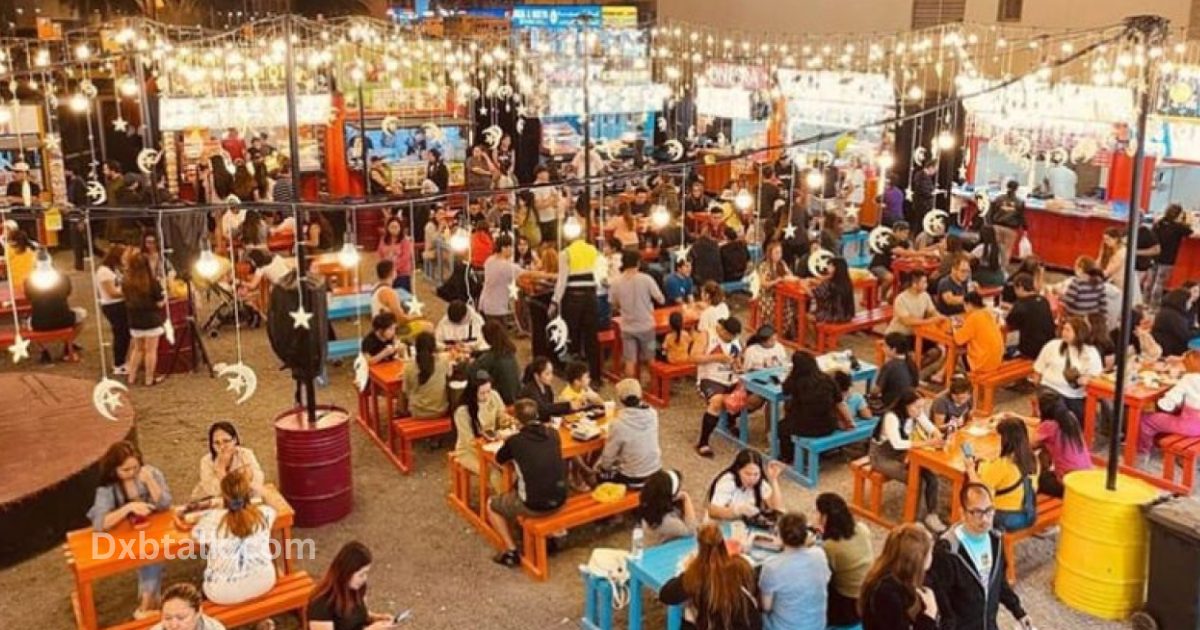
Satwa’s street food does not announce itself. There is no market hall, no official trail, no ribbon of branded stalls — just a working neighbourhood whose pavements happen to cook: a shawarma spit turning behind a cafeteria window, samosas emerging from a fryer in batches timed to the evening crowd, a juice man working through a crate of oranges, karak poured from a height to froth it. The scene rewards the browser over the planner. Come hungry, walk slowly, buy small and often, and let the district serve you its street food in the order it serves itself.
The Shawarma Stand, Taken Seriously
Begin where every Satwa evening begins. The district’s shawarma stands range from cafeteria counters to dedicated windows, and the residents’ judging criteria are exact: the meat stack visibly layered and cooking at its edges, carved to order rather than held, bread warmed against the grill, garlic sauce with conviction, pickles for the cut-through. A chicken shawarma with everything, eaten standing within sight of the spit that made it, is the scene’s foundational experience — cheap, perfect and gone in four minutes. The connoisseur’s moves are small ones: ask for it spicy if you take heat, watch for the stands where the queue is made of taxi drivers and shop staff, and never accept a wrap that has been sitting. The turnover is the freshness guarantee.
Falafel, Samosas and the Fryer Economy
The vegetarian half of the street runs on fryers, and Satwa’s are kept honest by volume. Falafel should be ordered where it is fried in small batches through the evening — green-flecked, crisp outside, steaming within — and eaten in the sandwich form, with tahini, salad and pickles in warm bread, rather than as a plated afterthought. Samosas run the same economy with a South Asian accent: potato and pea as the standard, minced meat for the carnivores, pastry that shatters audibly, a tamarind or mint chutney for the dipping. Around them orbit the supporting snacks of two continents — pakoras in the rainy-season style, kebab rolls, grilled corn, roasted nuts from the carts. The rule of the fryer economy is timing: these foods live for five minutes, so buy them at the moment of appetite, in quantities of now.
📸 Follow @dxbtalk1 on Instagram for daily Dubai in photos →
Karak and the Juice Stands: The Liquid Course
No Satwa food walk is properly punctuated without its drinks, and the district pours two. Karak — the strong, sweet, spiced milk tea that is Dubai’s true national beverage — comes from cafeteria counters and tea stalls in small glasses and paper cups, brewed in pots that never seem to empty, and functions socially as much as refreshingly: it is the pause between stops, the drink you hold while deciding the next one. The juice stands are its fresher counterpoint — oranges, sugarcane, mangoes and the famous mixed “cocktails” layered by colour, pressed and blended to order in front of you. A sugarcane juice with ginger after a round of fried food is the local palate cleanser; a karak after the sweets is the full stop. Build both into the walk deliberately. They are courses, not accessories.
The Grill Smoke at Night
As the evening deepens, the grills take over. Kebab houses and cafeteria grills work the pavement edges — seekh kebabs, tikka, arayes and grilled chicken perfuming whole street corners — served with fresh naan or pita, onions, and the spicy sauces each house guards. This is Satwa’s dinner layer: portable, smoky, eaten at pavement tables with the district flowing past. The ordering skill is restraint in service of range — one skewer here rather than the mixed grill, because the next corner has its own fire going and the walk is long. Follow the smoke and the clusters of regulars; a grill cooking for the neighbourhood’s own night shift has no need to impress anyone, and impresses everyone.
The Hidden Kitchens Behind the Stalls
The stalls are the visible scene; the connoisseurs know the layer behind it. Satwa’s side streets hold tiny family eateries — a Filipino grill house, a Pakistani cafeteria with six tables, a Yemeni spot whose bread arrives from a clay oven — where dishes the street versions only suggest are cooked whole: stews, biryanis by the platter, breakfasts that draw their communities across the city. Finding them is the district’s favourite game: ask a shopkeeper where he eats, follow a lunchtime queue into a doorway, accept the recommendation of the man at the next pavement table. These rooms do not advertise because they have never needed to. A street food walk that ends in one — full, unhurried, already planning the return — has done Satwa properly. The district’s final lesson is the one printed on no sign: the best street food in Dubai is not hidden. It is simply not staged, and it feeds the people who live here first.






Join the conversation