Most cities speak one architectural language. Dubai’s mosques speak at least five. Within a single day’s drive you can stand before a white Fatimid-style landmark in Jumeirah, an Ottoman cascade of domes in Al Safa, a Persian-tiled jewel in Bur Dubai, a coral-toned traditional mosque in the old quarters and a glowing contemporary cube in DIFC. Learning to read these mosque architecture styles turns every Dubai drive into a quiet gallery tour.
This guide is a field companion: what to look for in domes, arches, minarets and calligraphy, and where in the city each style shines.
Fatimid Elegance: Jumeirah’s White Stone
The Fatimid style, seen most famously at Jumeirah Mosque, favours carved stone, refined proportions and serene symmetry. Look for a large central dome flanked by twin minarets, horseshoe arches and delicate geometric carving that rewards a close look rather than shouting from afar. The mood is calm confidence — beauty through balance. Floodlit at night, Fatimid detailing glows, which is why Jumeirah Mosque, built in the 1970s and pictured on the 500-dirham note, remains the city’s most photographed mosque.
Ottoman Grandeur: The Blue Mosque of Al Safa
Ottoman design is the architecture of empires: a mighty central dome ringed by half-domes stepping downwards, pencil-slim minarets with balconies, and interiors washed in colour — above all the famous blues. Dubai’s exemplar is the Al Farooq Omar Bin Al Khattab Mosque in Al Safa, modelled on Istanbul’s Blue Mosque. Stand back to admire the cascade of the roofline; step closer (from the street) to enjoy the tilework. Where Fatimid whispers, Ottoman sings.
📸 Follow @dxbtalk1 on Instagram for daily Dubai in photos →
Persian Colour: Tilework in Bur Dubai
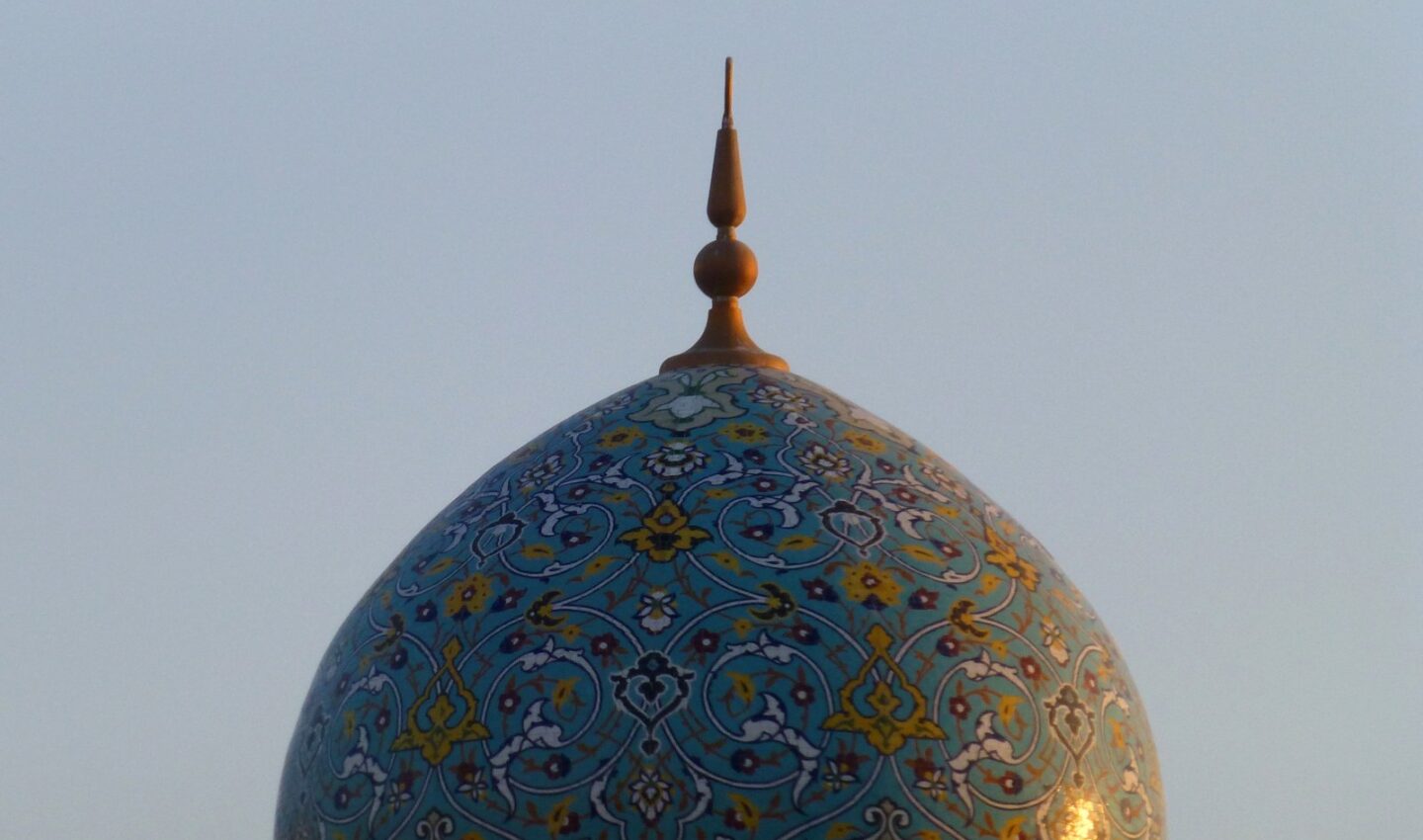
Persian style announces itself in tile. Glazed mosaics in turquoise, cobalt and floral patterns can cover entire façades, turning walls into gardens that never wilt. Dubai’s treasure here is the Iranian Mosque — the Ali ibn Abi Talib Mosque near the Textile Souk — whose façade is a masterclass in the craft. Look for interlacing flowers, geometric stars and bands of flowing calligraphy. Persian mosques also favour the pointed iwan arch, a grand framed portal that gives entrances their ceremonial lift.
Gulf Vernacular: The Old Town’s Own Voice
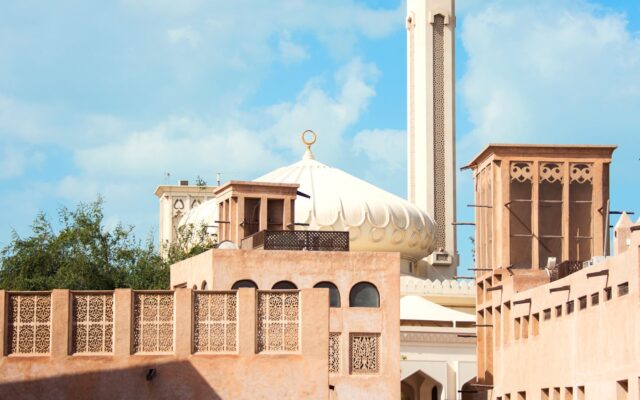
Before imported styles, the Gulf built its own: mosques of coral stone, gypsum and palm-rib ceilings, thick walls against the heat, modest minarets and shaded courtyards. Survivals and successors of this Gulf-vernacular tradition stand through Al Fahidi, Deira and the older districts, including the area around the Grand Mosque in Bur Dubai with its famously tall minaret. Their beauty is honesty — local materials, climate-wise design, decoration kept simple so that community, not ornament, fills the space.
The Modern Language: Glass, Light and Geometry
Contemporary Dubai adds a fifth voice. The DIFC Grand Mosque at Gate Avenue reimagines the mosque as a patterned cube, its geometric screen filtering light like a modern mashrabiya. Elsewhere, newer neighbourhood mosques experiment with crisp white forms, sculptural minarets and eco-friendly engineering — the Khalifa Al Tajer Mosque in Deira being widely described as the region’s first eco-friendly mosque, with solar power and water saving built in. The vocabulary is new; the grammar — symmetry, geometry, light, orientation — is a thousand years old.
- Domes: single and serene (Fatimid), cascading (Ottoman), or reimagined as clean modern forms
- Minarets: twin and carved, pencil-slim, or sculptural and minimal
- Arches: horseshoe, pointed iwan and simple Gulf round arches
- Decoration: carved stone, blue tile, Persian mosaics or patterned screens
- Always present: the mihrab marking the direction of prayer, the minbar, and calligraphy honouring the word
How to Look on Your Next Drive
Start at the roofline: domes tell you the family. Move to the minarets, then to the surface — stone, tile, plaster or screen. Finally, look for calligraphy, the signature of every style. Remember that these are working mosques: admire from the street, photograph architecture rather than worshippers, and for an interior explained by a guide, visit Jumeirah Mosque on a Sheikh Mohammed Centre tour.
Do this for a week and Dubai changes. The mosques stop being background and become a conversation across centuries and continents — Fatimid Cairo, Ottoman Istanbul, Persian Isfahan, old Arabia and the future, all within one city’s boundaries, all calling the same city to prayer. Better still, bring a friend or your children along and turn the spotting into a game, because once your eyes learn these patterns, every neighbourhood walk becomes richer, slower and far more beautiful than before.