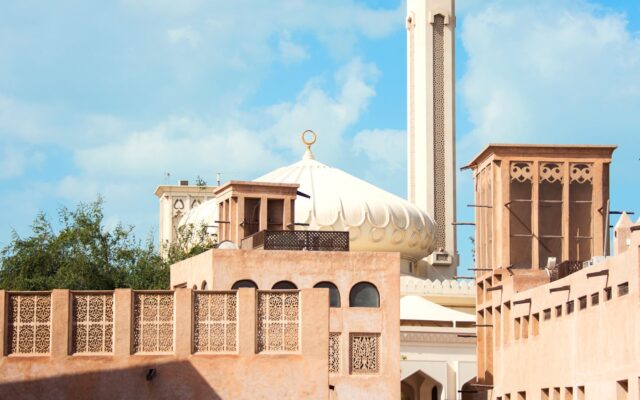
Stand on the Bur Dubai side of Dubai Creek at late afternoon and one landmark draws your eye above the old rooftops: the soaring minaret of the Grand Mosque. It rises beside the Dubai Museum and the busy lanes of the historic quarter, pale and elegant against the sky, while wooden abras criss-cross the water below. In a district of souks, wind towers and trading history, this mosque feels like the anchor of old Dubai.
The Grand Mosque is among the city’s oldest and largest places of worship, and it has been rebuilt and renewed over the years as Bur Dubai itself has changed. What has never changed is its role. For generations of traders, sailors, shopkeepers and families on this side of the Creek, it has been the place where the day is measured not only by business, but by prayer.
The Minaret That Marks the Old Town
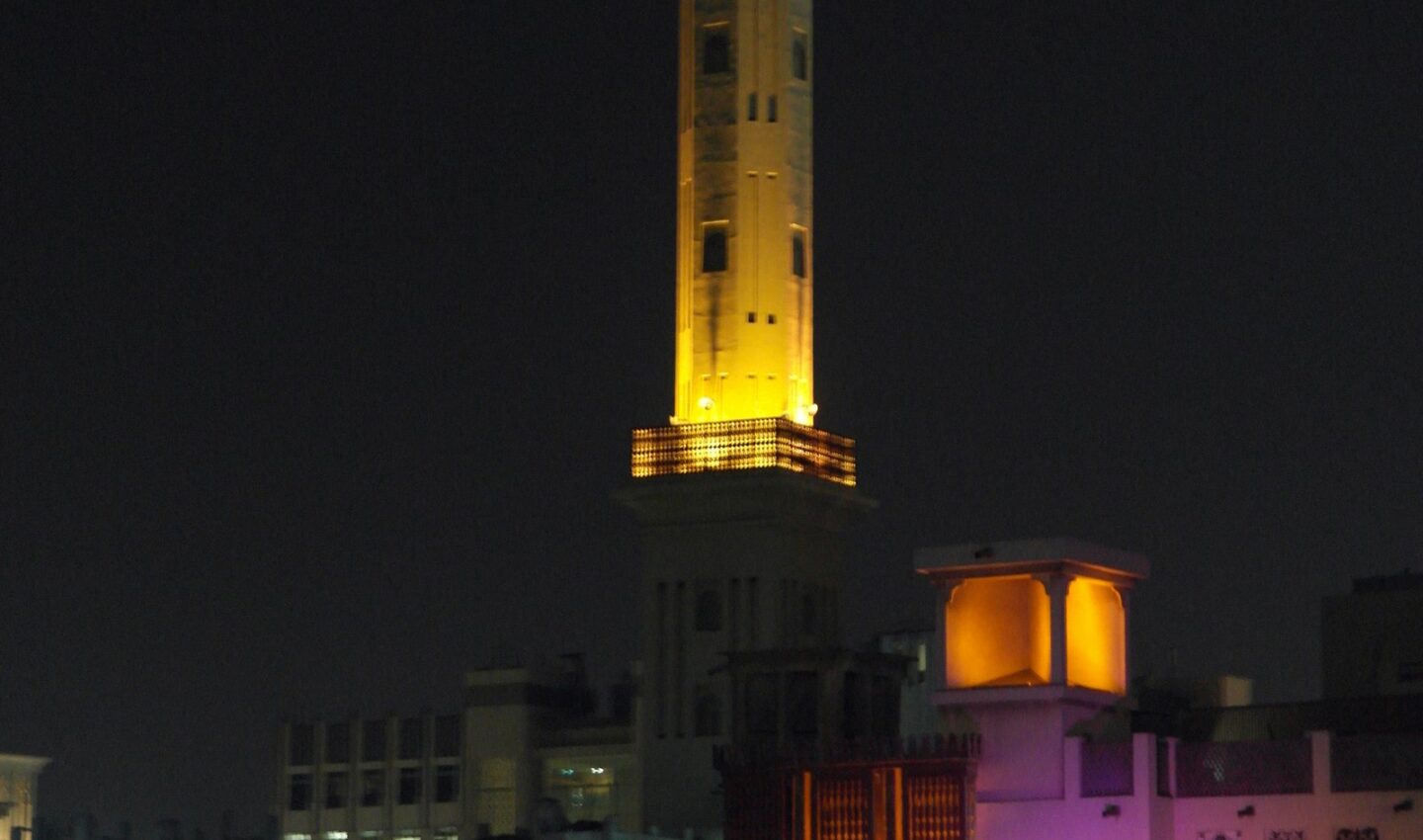
The mosque is best known for its very tall minaret, counted among the tallest in the city. In the days before skyscrapers, it would have been the highest point for miles — a beacon you could navigate by from the water or from the alleys of Al Fahidi. Even now, with towers glittering across the Creek in Deira, the minaret holds its own. It belongs to an older skyline, and it gives the whole historic district its sense of place.
The building itself is kept in warm, sandy tones that suit the old town, with traditional detailing rather than flashy decoration. That restraint is part of its charm. The Grand Mosque does not compete with the souks and museums around it; it completes them, reminding every visitor that commerce and faith grew up side by side on these banks.
Prayer Beside the Creek
Through the day, worshippers slip in from the surrounding streets — textile merchants from the souk, museum staff, taxi drivers on a break, grandfathers who have prayed here for decades. At the midday and afternoon prayers the hall fills in waves, then empties just as quickly back into the rhythm of the old town.
Friday is different. Friday prayer, or Jummah, brings the whole neighbourhood together. Rows fill early, the courtyard throngs, and afterwards the lanes around the mosque become a gentle festival of greetings. Families head off for lunch, friends linger over tea, and visitors watching from a respectful distance get a glimpse of Bur Dubai at its most communal. Prayer times change daily, so worshippers check the official UAE calendar or a prayer times app for the day.
📸 Follow @dxbtalk1 on Instagram for daily Dubai in photos →
Many Nationalities, One Congregation
Bur Dubai has always been a trading crossroads, and the Grand Mosque’s congregation reflects it beautifully. In a single row you might find an Emirati elder beside a trader from India, a craftsman from Pakistan beside a shopkeeper from Iran, and a young professional from the Philippines or East Africa. Languages differ, clothes differ, homelands differ — but in prayer everyone faces the same direction, in the same lines, at the same time.
That unity is easy to take for granted in Dubai, yet at the Grand Mosque it feels especially vivid because the setting is so historic. The same streets that once welcomed pearl divers and merchants from across the Indian Ocean now welcome their grandchildren, praying together where their families have prayed for generations.
Visiting the Area Respectfully
Most mosques in Dubai, including this one, are for worshippers rather than sightseeing, and entry for non-Muslim visitors is limited. The Grand Mosque is best admired from outside as part of a walk through historic Bur Dubai — combine it with the Dubai Museum, the Al Fahidi Historical Neighbourhood and a one-dirham abra ride across the Creek. If you long to see inside a mosque, the guided tours at Jumeirah Mosque, run by the Sheikh Mohammed Centre, are the welcoming route designed for visitors.
- Look for: the tall minaret from the Creek and the Baniyas Road side
- Combine with: Dubai Museum, Al Fahidi and the Textile Souk
- Be mindful: dress modestly in the area and avoid photographing worshippers
- Busiest moment: Friday midday, when the whole quarter gathers
The Heartbeat of Historic Dubai
Every city has buildings that explain it. In Bur Dubai, the Grand Mosque is one of them. It speaks of a time when the Creek was the whole economy, when the call to prayer carried across open water, and when a tall minaret was the proudest sight on the skyline.
Visit at sunset, when the light softens on the minaret and the abras light their lamps for the evening crossings, and you will feel it: this is not just a mosque beside the Creek. It is the quiet, faithful heart of the oldest Dubai of all.