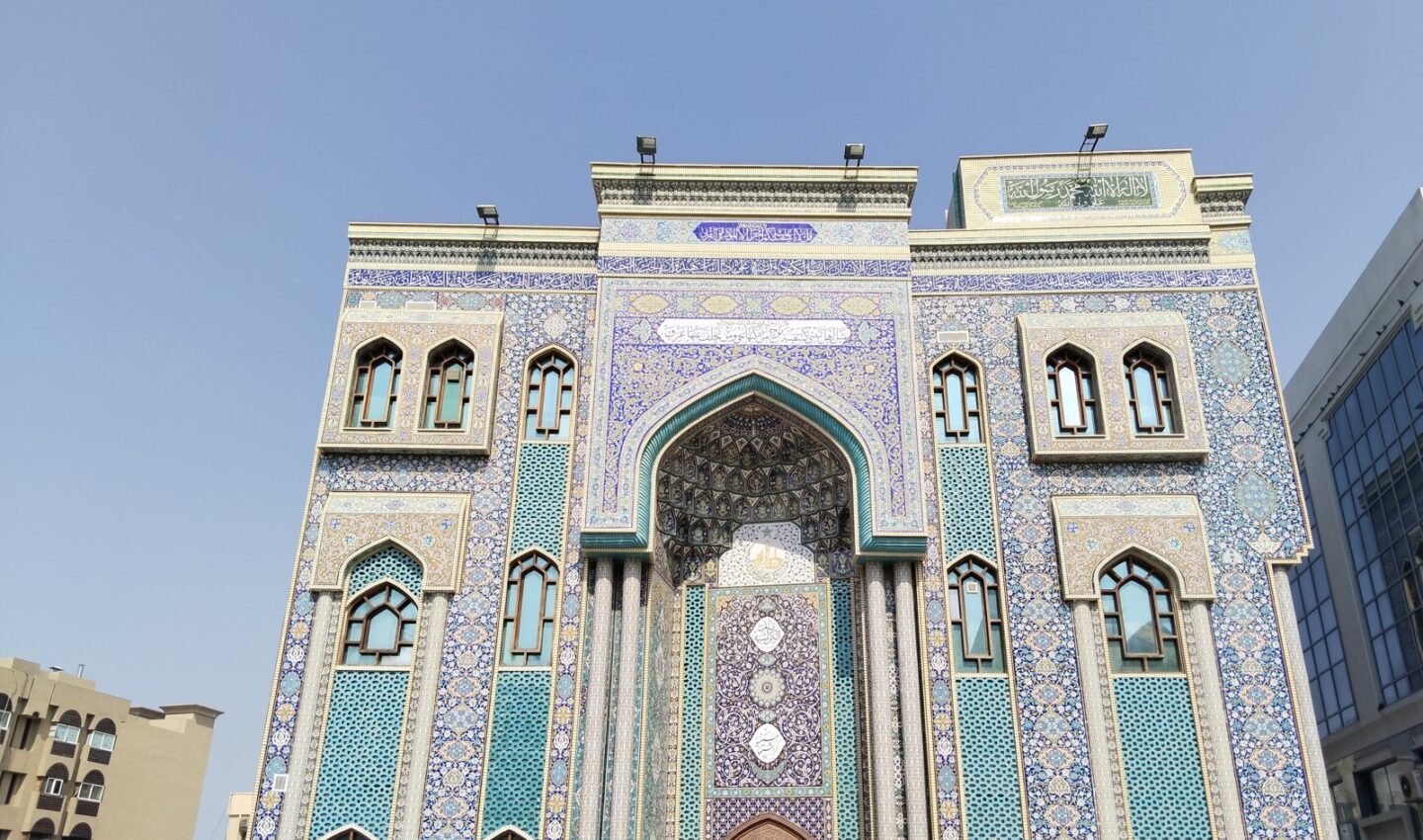
Old Dubai keeps its colours in unexpected places. Walk the lanes behind the Textile Souk in Bur Dubai, past bolts of bright fabric and the scent of oud, and suddenly a façade erupts in turquoise, cobalt and gold. This is the Iranian Mosque, formally the Ali ibn Abi Talib Mosque — the most richly decorated mosque exterior in the old town, and one of the most photographed walls in Dubai.
In a district of sand-coloured buildings and coral-stone houses, the mosque is a joyful exception. Its Persian tilework covers the façade in intricate floral patterns, geometric stars and flowing calligraphy, each tile placed by hand into a shimmering whole. It stops passers-by mid-step, every single day.
A Façade Like a Persian Garden
The decoration rewards slowness. Blues dominate — the turquoise of shallow water, the deep blue of midnight — but look closer and you will find greens, yellows, pinks and white woven through the designs. Flowers repeat and interlace. Arches are outlined in pattern upon pattern, so the whole wall feels alive, like a garden translated into glazed clay.
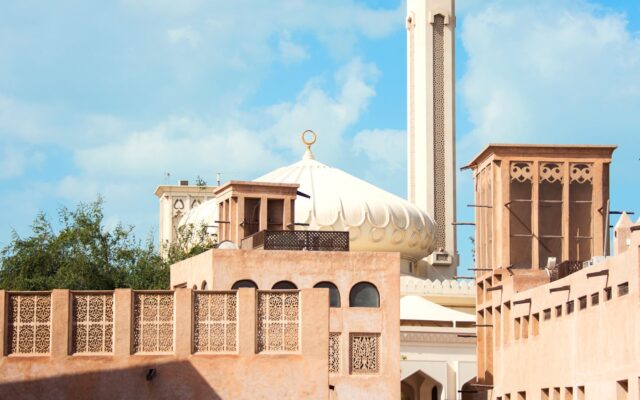
This style travelled to Dubai the way so much of the old town’s character did: across the water, with the merchants and craftsmen who traded between the Gulf ports for centuries. Bur Dubai was never an isolated village. It was a meeting place of Arabia, Persia, India and East Africa, and the Iranian Mosque is that history made visible — Persian art at home on an Arab creekside street.
At Home in the Old Town
The mosque stands near the Textile Souk, in the warren of lanes where the Creek’s trading life still hums. Around it are tailors, fabric shops, small cafeterias and the covered walkways that lead down to the abra stations. Worshippers weave prayer into the working day here exactly as their predecessors did: a shop shutter half-pulled at prayer time, a short walk, a quiet hall, then back to the counter.
Because it sits in one of Dubai’s most visited historic areas, the mosque also plays an unintended role as an ambassador. Thousands of visitors who might never enter a mosque still stand before this façade and feel something — curiosity, admiration, warmth. Beauty has a way of opening conversations that words cannot.
📸 Follow @dxbtalk1 on Instagram for daily Dubai in photos →
Prayer in a Multicultural Quarter
Step back at prayer time and watch who arrives: Iranian families whose roots in Bur Dubai go back generations, Emirati neighbours, South Asian traders from the souks, Arab workers from nearby offices. The congregation mirrors the quarter itself — layered, multilingual and entirely at ease with its diversity.
Inside the rows, those differences fall away in the familiar Dubai pattern. Everyone stands shoulder to shoulder. Children imitate their fathers. Elders are greeted with particular affection. Afterwards, the lanes fill again with the souk’s polyglot chatter, and the mosque settles back into its role as the decorated, beating heart of the street. Prayer times change daily, so check the official UAE calendar or a prayer times app for the day.
How to Enjoy It as a Visitor
The Iranian Mosque is a place of worship, and like most mosques in Dubai it is not run as a visitor attraction; non-Muslim entry is limited and should not be assumed. The great gift of this mosque to visitors is its exterior, which can be admired freely and respectfully from the street. Combine it with a morning wander through the Textile Souk, the Al Fahidi Historical Neighbourhood and a Creek crossing by abra.
- Look for: turquoise and cobalt Persian tiles, floral motifs and calligraphy bands
- Best light: morning, when the tiles glow without harsh glare
- Nearby: Textile Souk, Dubai Museum and the abra stations
- Remember: photograph the façade, not worshippers; keep lanes clear at prayer times
If you wish to experience the inside of a mosque on a guided visit, Jumeirah Mosque’s tours through the Sheikh Mohammed Centre are the route created for that purpose.
The Old Town’s Jewel
Dubai’s modern image is glass, chrome and height. The Iranian Mosque tells the older, equally true story: of craftsmen and traders, of art carried across the Gulf, of faith expressed in colour and patience. Each tile was shaped, glazed and set by human hands — thousands of small acts of devotion forming one radiant wall.
Stand before it as the morning sun strikes the turquoise, with the souk stirring around you and the Creek glittering at the end of the lane, and you will carry the image for years. In the heart of old Dubai, this is faith wearing its most beautiful colours.