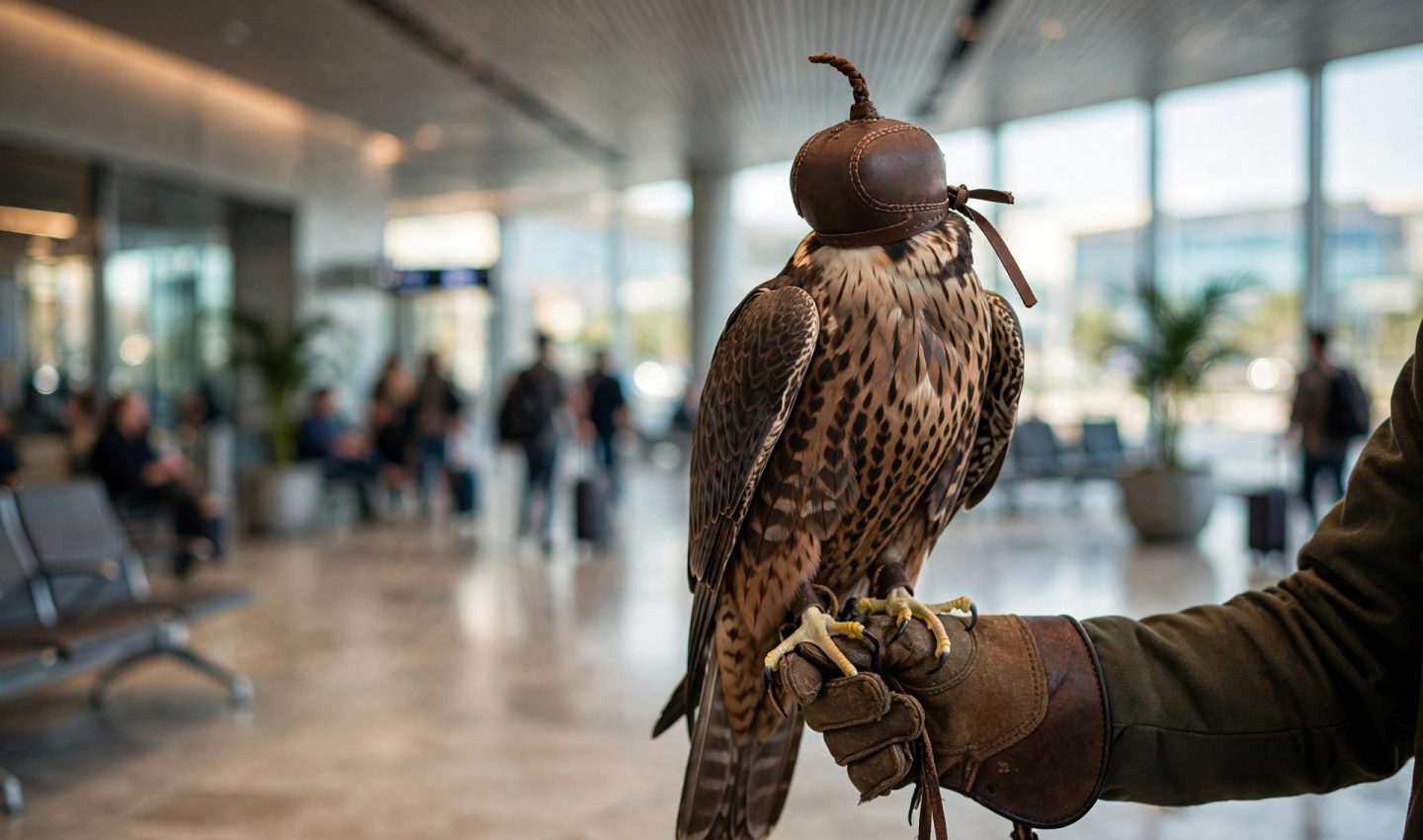
At a Gulf airport, among the business travellers and holidaymakers, you may spot a passenger with an unusual travelling companion: a hooded falcon, perched calmly on a gloved arm, flying in the cabin like any other valued guest. Ask to see its documents and you will find the surprise is real — the bird has its own passport. In the UAE, falcons have carried passports since 2002, making them quite possibly the best-documented birds on Earth.
Why a Bird Needs a Passport
Falconry is not a hobby in the Emirates; it is heritage, woven into Bedouin survival in the desert and now protected as living culture. It is also valuable — a prized hunting falcon can be worth a great deal of money — and that value attracted a dark trade. Wild falcons were being trapped and smuggled across borders, threatening wild populations and fuelling an illegal market. The UAE’s answer, introduced in 2002, was documentation: a passport system for falcons, recording each bird’s identity, species and owner, tied to a leg ring and identification details. A falcon travelling legally carries papers; a bird without them raises immediate questions.
How Falcon Travel Works
The passport allows a registered falcon to cross borders with its owner for hunting trips, competitions and veterinary care without fresh permits for every journey — the document is typically valid for several years. Airlines in the region know the drill well. Falcons travel in the cabin, hooded to keep them calm, sometimes occupying a seat beside their owner; widely reported images over the years have shown rows of falcons travelling together when a hunting party moves for the season. Falconers travel to Central Asia and elsewhere for the hunting season, and the birds return the same way — checked through airports with the same bureaucratic calm as a family with suitcases.
📸 Follow @dxbtalk1 on Instagram for daily Dubai in photos →
More Than Paperwork
The passport sits inside a wider system of care and conservation. Abu Dhabi is home to a famous falcon hospital — widely described as the largest of its kind in the world — where birds receive everything from feather repairs to surgery, and where the passport and ringing records help track each patient. Breeding programmes in the UAE now produce many hunting falcons in captivity, reducing pressure on wild populations, and release programmes return birds to the wild. The documentation that began as an anti-smuggling measure became the backbone of a regulated, traceable culture: every legal bird accounted for, from chick to hunting season.
Free Dubai Tools
Dubai, in Your Hands
A Symbol That Travels
There is something perfectly Emirati about the falcon passport. The bird on the national emblem and the banknotes, the creature that once meant survival in the desert, now moves through the most modern airports in the world carrying state-issued ID. It is heritage, but administered with databases. If you ever find yourself seated near one, be polite and do not be surprised — the falcon is a frequent flyer, and unlike most passengers, all of its paperwork is definitely in order.
Practical Notes
- Spotting one: falcons are most often seen in Gulf airport terminals during the hunting season, roughly the cooler months, travelling hooded on their owners’ arms.
- Do not touch: a hooded falcon is calm but working — admire from a distance and always ask the owner before taking photographs.
- See the culture: falconry displays feature at heritage festivals and desert experiences across the UAE in winter.
- The hospital: the Abu Dhabi Falcon Hospital offers guided tours where you can see the birds and their care up close.
- Collect them all: find more world-firsts and records in our Dubai world records and firsts collection.
DXB FACT — DID YOU KNOW?
Snow in the middle of the desert
- Ski Dubaithe Middle East's first indoor ski resort
- Real snow22,500 m² of it
- Inside temperature−1°C to −4°C, all year
- Slopes5 — including an indoor black run
Source: The National
A new Dubai fact every dayRead more »
Reader poll
Poll of the Day
A fun reader poll, just for curiosity — not an official survey. A new question arrives every day.