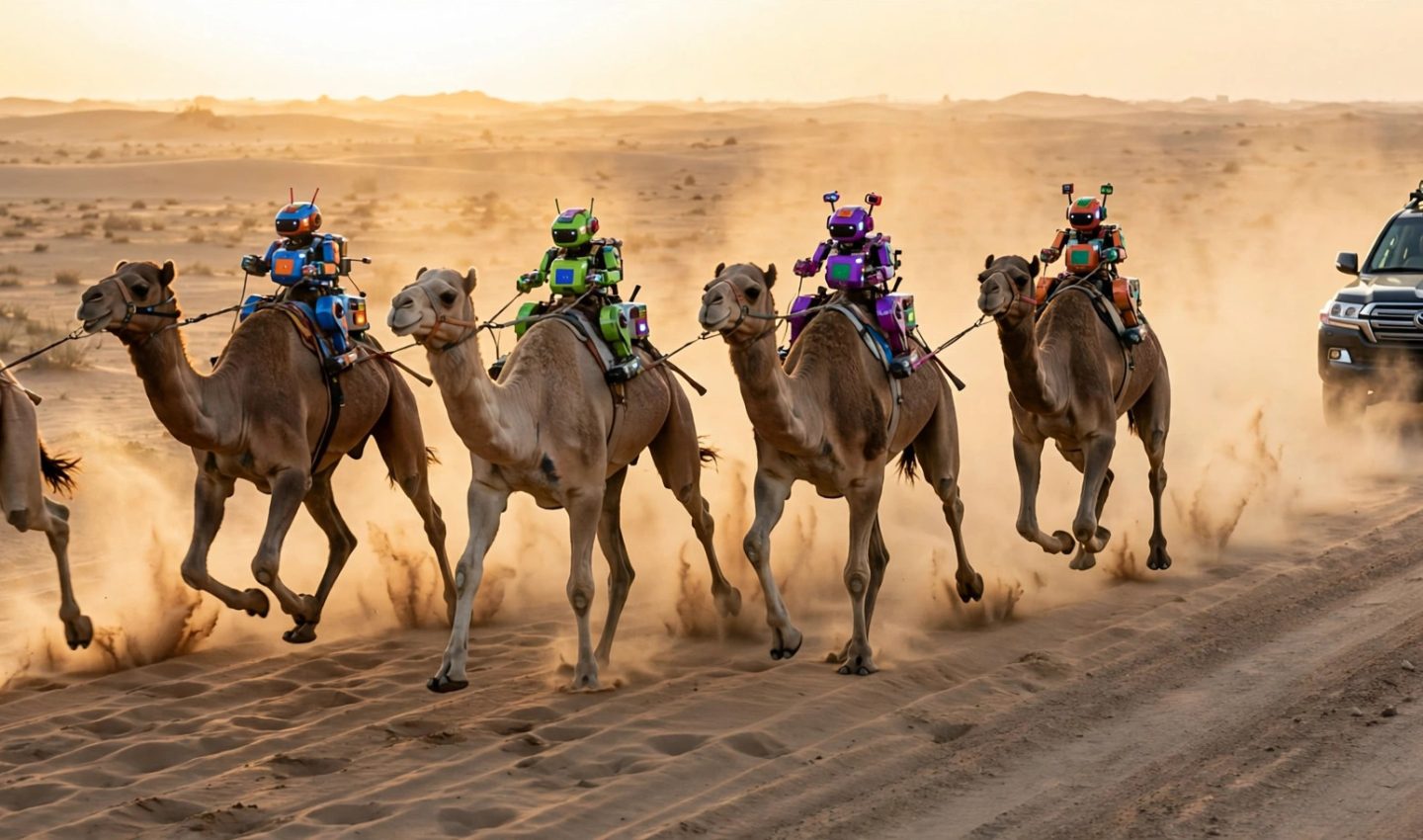
At a camel race in the UAE, the scene looks almost normal: beautiful racing camels thundering down a long desert track, owners’ SUVs pacing them along a parallel road, shouting encouragement. Then you look closer at the jockeys. They are tiny, brightly coloured — and made of plastic and aluminium. They are robot jockeys, and they replaced one of the sport’s darkest chapters with one of its strangest and best inventions.
The Problem Camel Racing Faced
Camel racing is an ancient and beloved sport in the Gulf, but for years it carried a shameful secret. Because light weight wins races, small children — some very young, many trafficked from abroad — were used as jockeys, in dangerous and abusive conditions that drew international condemnation. The UAE moved to end it: laws banning child jockeys were introduced and progressively tightened in the early 2000s, with a comprehensive ban enforced from 2005. But a ban alone left a question. Camels had been ridden by small, light riders for generations. What would ride them now?
Enter the Robots
The answer, developed in the mid-2000s, was the robot jockey. The first versions were simple: a small lightweight frame — little more than a box with arms — dressed in racing silks and strapped onto the camel’s back. Owners controlled them remotely from the SUVs driving alongside the track, using a remote control to rotate a small whip arm and, in many designs, to shout encouragement through a small speaker. The camel hears its owner’s voice, feels the tap of the whip, and races as it always has. The technology improved quickly: later models gained a more humanoid shape, better balance and features like heart-rate monitoring of the camel, but the principle stayed delightfully simple.
📸 Follow @dxbtalk1 on Instagram for daily Dubai in photos →
Racing Day With Robots
Race meetings at tracks such as Al Marmoom in Dubai now run with fields of robot-ridden camels, and the spectacle is both serious sport and gentle comedy. The robots bounce and jolt with the camel’s stride, occasionally — to the crowd’s delight — losing their balance entirely. Owners, meanwhile, are fully occupied: driving, steering their attention between track and remote control, and bellowing into the radio. Prize money and prestige remain entirely real; top racing camels are valuable athletes, bred and trained with the seriousness of racehorses. The sport did not shrink when the robots arrived — freed from scandal, it grew, with better tracks, bigger meetings and a clear conscience.
Free Dubai Tools
Dubai, in Your Hands
A Small Machine, A Large Point
The robot jockey is often told as a quirky story, and it is — but it is also a model of how the UAE handles a certain kind of problem: keep the tradition, remove the harm, engineer the difference. Falconry got passports and hospitals; camel racing got robots. The camels, for their part, seem untroubled by the change. They run exactly as fast for a machine in silks as they ever did — which, in the end, is the whole point of the sport.
Practical Notes
- Where to watch: Al Marmoom Camel Racing Track, on the Al Ain road out of Dubai, hosts the emirate’s main race meetings.
- When: racing is a winter sport — meetings run roughly from October to April, usually early in the morning.
- Training runs: camels train on and around the tracks at dawn; even outside race days, the area is alive with herds and handlers.
- Cost: spectating at the track is generally free and informal — bring water, a hat and patience.
- Combine it: Al Marmoom sits near desert experience areas; see our Dubai travel ideas for building a morning around it.
DXB FACT — DID YOU KNOW?
Snow in the middle of the desert
- Ski Dubaithe Middle East's first indoor ski resort
- Real snow22,500 m² of it
- Inside temperature−1°C to −4°C, all year
- Slopes5 — including an indoor black run
Source: The National
A new Dubai fact every dayRead more »
Reader poll
Poll of the Day
A fun reader poll, just for curiosity — not an official survey. A new question arrives every day.