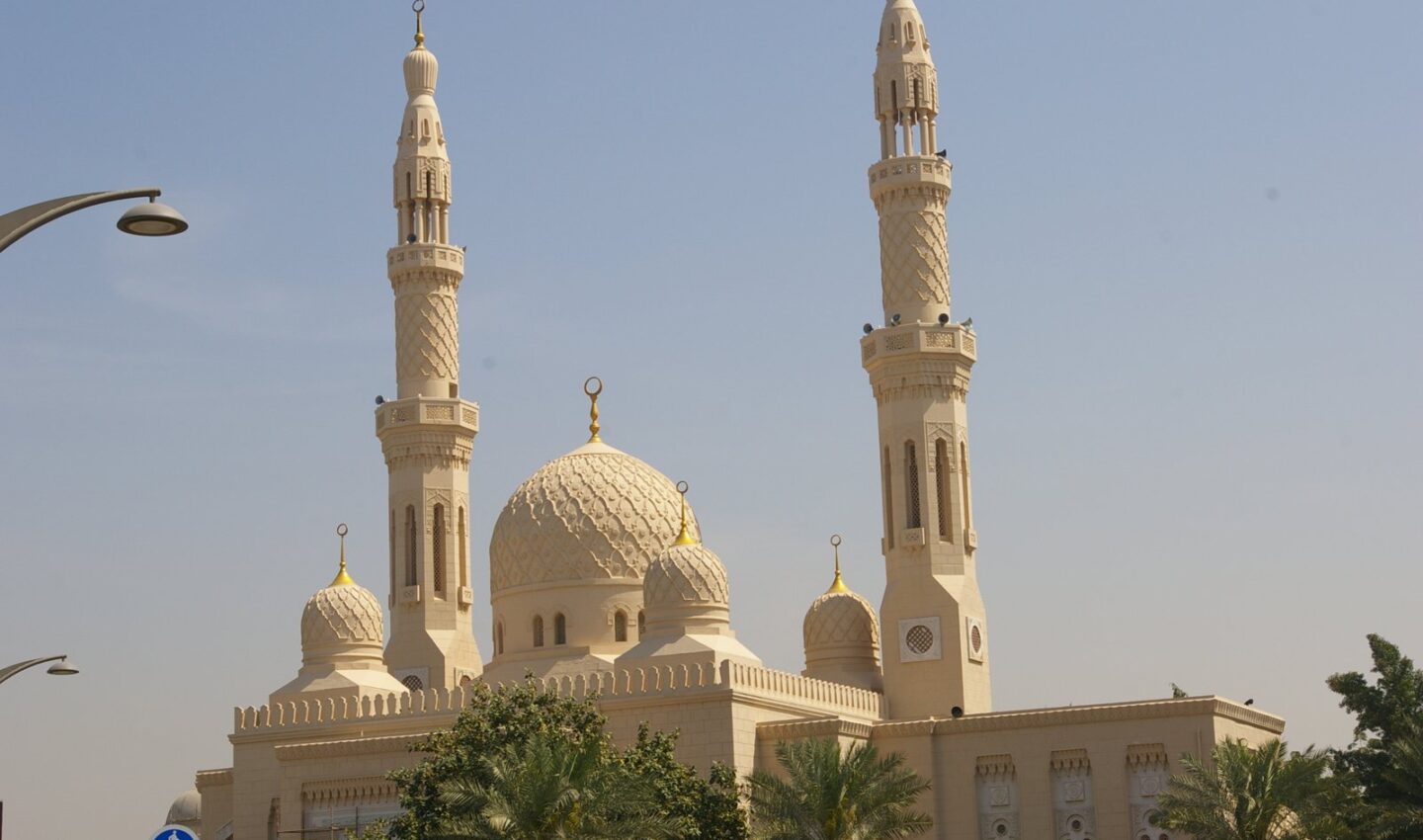
Drive along Jumeirah Beach Road at dusk and one building slows you down every time. Behind a low wall and a fringe of palms, Jumeirah Mosque glows in warm white stone, its twin minarets rising either side of a broad central dome. It is not the tallest mosque in Dubai and it is not the largest, yet for many people it is the most loved — a calm, beautiful landmark that has watched the city grow from a quiet coastal strip into a world capital.
The mosque was built in the 1970s, and its image is so woven into Dubai life that it appears on the 500-dirham note. That small honour says a great deal. Long before the record-breaking towers, this was a building the emirate chose to represent itself: elegant, welcoming and unmistakably rooted in Islamic art and architecture.
A Building in the Fatimid Style
Jumeirah Mosque is built in the Fatimid style, a tradition known for finely carved stone, graceful arches and a sense of balance rather than sheer scale. The pale stone catches the light beautifully through the day — soft and almost golden in the morning, bright white at noon, and warm amber as the sun drops towards the Gulf. Look closely and you will see delicate geometric carving, horseshoe arches and a crown of small domes around the main dome.
The twin minarets frame the façade in perfect symmetry. In the evening, when the floodlights come on, the whole building seems to float above the road. Photographers love that hour, and so do local families, who often pause on evening walks just to admire it. It is a reminder that Dubai’s beauty is not only in glass and steel, but in stone, proportion and quiet detail.
Open Doors, Open Minds
What makes Jumeirah Mosque truly special is that it opens its doors to everyone who wishes to learn. Most mosques in Dubai are places of worship for Muslims, and visitors should not expect to walk into any mosque uninvited. Jumeirah is the famous exception. Through the Sheikh Mohammed Centre for Cultural Understanding, it hosts the well-known Open Doors, Open Minds guided tours.
On a tour, guests are welcomed inside the prayer hall, where a guide explains what happens at prayer, points out features such as the mihrab and minbar, and answers questions over Arabic coffee and dates. Visitors are asked to dress modestly, and women are offered a headscarf to wear during the visit. Tour days and times can change, so it is always worth checking the Centre’s current schedule before you go.
📸 Follow @dxbtalk1 on Instagram for daily Dubai in photos →
Where Many Nations Pray Side by Side
Come here at prayer time and you will see the other side of the mosque’s life — not as a landmark, but as a living place of worship. Worshippers arrive from every corner of the city and, indeed, the world. Emiratis stand beside Pakistanis and Indians, Filipinos beside Egyptians, Somalis beside Bangladeshis and converts from Europe and East Asia. In the rows of prayer there is no reserved place for the wealthy and no corner for the poor. A manager and a delivery rider may stand shoulder to shoulder, feet in the same line, bowing at the same moment.
That quiet equality is one of the most moving sights in Dubai. After prayer, the courtyard fills with greetings in a dozen languages — handshakes, smiles and brief conversations between people who might never have met anywhere else. The mosque gives the neighbourhood a shared heartbeat, five times a day.
When to See It at Its Best
If you are visiting as an admirer rather than a worshipper, golden hour is unforgettable. Arrive before sunset, admire the façade from across the road, and watch the light change on the stone. After dark, the floodlit view from Jumeirah Beach Road is one of the classic Dubai photographs — but please be respectful: photograph the building, not worshippers at prayer, and keep voices low near the entrances.
- Best light: just before sunset and in the first hour after dark
- Dress: modest clothing for tours; shoulders and knees covered
- Tours: book through the Sheikh Mohammed Centre and confirm the day’s schedule
- Prayer times: these change daily, so check the official UAE calendar or a prayer times app for the day
A Landmark That Still Belongs to Its Neighbourhood
For all its fame, Jumeirah Mosque remains a neighbourhood mosque first. Children learn its silhouette before they can read. Elders have prayed here for decades. New residents find in it a first, gentle introduction to the faith and culture of the city they now call home.
In a city famous for what is newest and tallest, Jumeirah Mosque is loved for the opposite reasons: for its calm, its symmetry and its open door. Stand before it at dusk, listen as the call to prayer rises over Jumeirah Beach Road, and you will understand why this white-stone mosque, built in the 1970s, still feels like the spiritual postcard of Dubai.