Long before the towers, before the ports, before a single barrel of oil, Dubai got rich on something far more delicate: pearls. For generations, the emirate’s dhows sailed out into the Gulf each summer and its divers came back — when they came back — with the finest natural pearls in the world.
The Summer Fleets
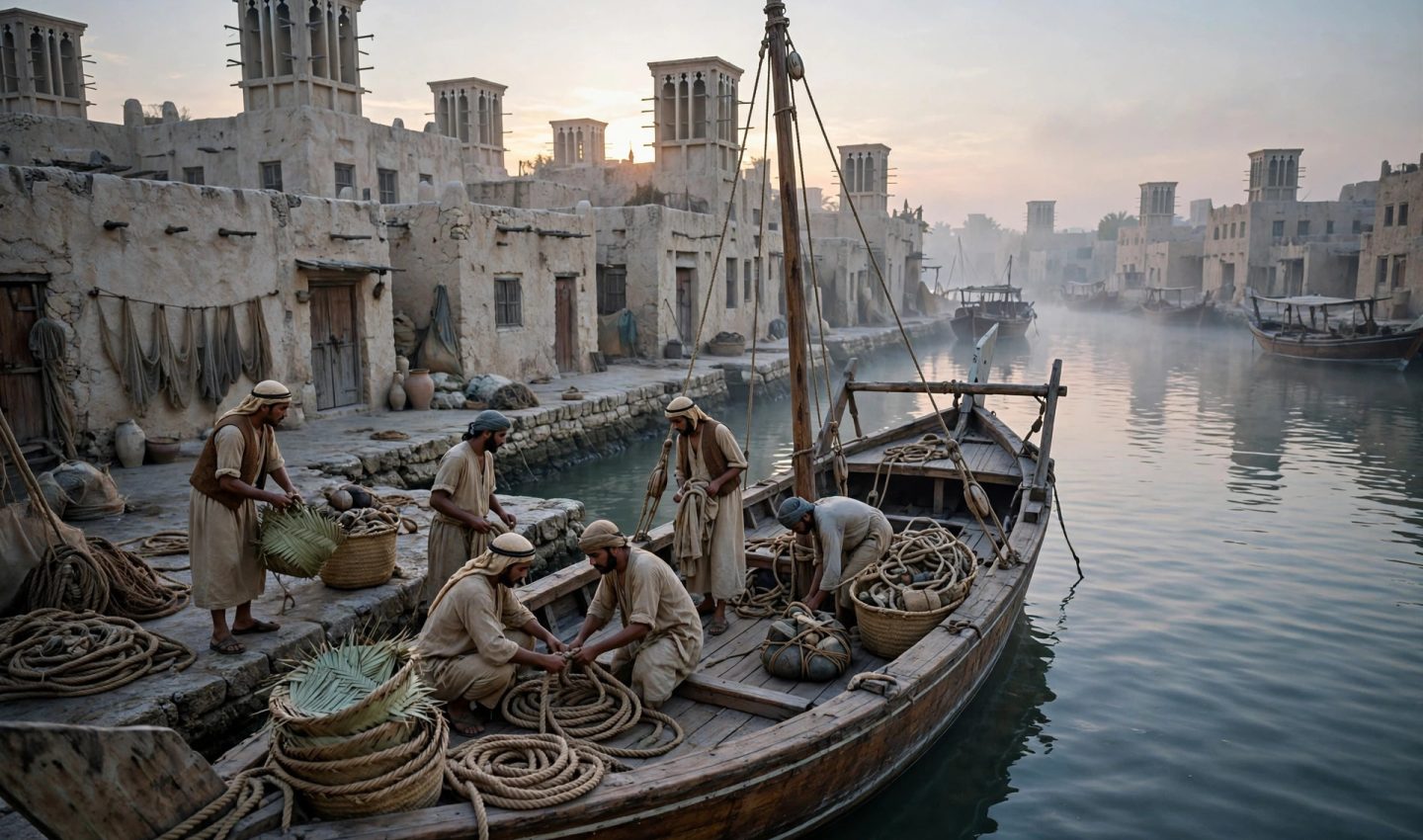
From roughly the mid-1800s into the early 1900s, pearling was the backbone of the Trucial Coast economy, and Dubai was one of its great ports. At the season’s height, hundreds of dhows and thousands of men left the Creek for the pearl banks. A crew might include a captain, haulers, cooks and the divers themselves — the ghawwas — who made the work famous and feared.
A diver’s tools were heartbreakingly simple: a nose clip, leather finger protectors, a rope around the waist and a stone weight to pull him down. He would descend ten metres or more on a single breath, fill his basket with oysters, and signal to be hauled up — then do it again, dozens of times a day, for months. Sharks, jellyfish and burst eardrums were occupational hazards; many divers were bound to boat owners by debts that rolled from season to season.
The season had its own name — the great dive — and its own rhythm. Fleets left as the summer heat peaked, when the Gulf’s waters were warmest and calmest, and stayed out for up to four months. Whole towns emptied of working-age men; women, children and old men ran the shore economy on credit extended against the harvest, and the entire Creek held its breath until the sails reappeared in autumn.
Why Dubai’s Pearls Ruled
The Gulf’s warm, shallow banks produced pearls prized in Bombay, Baghdad and Paris for their lustre. Dubai’s merchants — including the Indian Banyan traders who settled along the Creek — financed the fleets and carried the harvest to market. The money built the wind-tower houses of Bastakiya, filled the souks, and taught Dubai a lesson it never forgot: when you sit between the sea and the desert, trade is survival.
Free Dubai Tools
Dubai, in Your Hands
📸 Follow @dxbtalk1 on Instagram for daily Dubai in photos →
The Collapse of the 1930s
The end came with brutal speed. In the 1930s, Japan perfected the cultured pearl — rounder, cheaper and suddenly everywhere — just as the Great Depression crushed luxury demand in the West. Prices fell off a cliff. Within a few years the fleets that had sailed for a century stayed tied up along the Creek, and the town that pearls built faced genuine hardship. Families who had known nothing else scattered into trade, fishing and smuggling-era ingenuity to survive.
The timing, in hindsight, was fateful. Pearling’s death pushed Dubai’s rulers to double down on the one asset that remained: the Creek itself. It was dredged, its port expanded, its taxes kept low to lure the region’s trade — the direct ancestor of the free-port, logistics-first Dubai of today.
Practical Notes
- See it: Dubai Museum and the heritage houses of Al Fahidi still display divers’ weights, nose clips and oyster baskets from the pearling era.
- The Creek: the abra crossing between Deira and Bur Dubai follows the same water the pearl fleets used — it costs just AED 1.
- Real pearls: natural Gulf pearls are now rare and expensive; most “pearl” jewellery sold today is cultured — ask before you buy.
- Heritage season: traditional dhow races and heritage festivals still honour the diving era each winter.
Every glittering thing Dubai later became — the port, the trade, the towers — began with men holding their breath in warm green water, hoping the next oyster held a fortune.
DXB FACT — DID YOU KNOW?
Snow in the middle of the desert
- Ski Dubaithe Middle East's first indoor ski resort
- Real snow22,500 m² of it
- Inside temperature−1°C to −4°C, all year
- Slopes5 — including an indoor black run
Source: The National
A new Dubai fact every dayRead more »
Reader poll
Poll of the Day
A fun reader poll, just for curiosity — not an official survey. A new question arrives every day.