Every photographer in Dubai eventually makes the same pilgrimage — not to a viewpoint, but to a series of façades. White marble, carved stone and blue tiles: the city’s mosques offer some of the most beautiful architecture in the Gulf, and at golden hour they can stop even a jaded Instagrammer mid-scroll. This is a roundup for admirers and photographers alike — with one golden rule woven through it: in Dubai, the most beautiful shot is always a respectful one.
Mosques are homes of worship first and photo subjects second. Photograph buildings, never worshippers at prayer; admire courtyards from public space; and let prayer times pass in peace. Do that, and the city’s mosques will reward your camera generously.
Jumeirah Mosque: The Golden-Hour Icon
The essential frame. Jumeirah Mosque’s white Fatimid-style stone, twin minarets and central dome were made for the last light of day, when the façade turns from white to honey to amber. Built in the 1970s and honoured on the 500-dirham note, it is at its most magical just after the floodlights come on, against a deep blue dusk sky. Shoot from across Jumeirah Beach Road for the classic symmetrical composition, palms in frame. On a Sheikh Mohammed Centre tour, interior photography follows the guide’s instructions — always ask.
Al Farooq Mosque: A Study in Blue
In Al Safa, the Al Farooq Omar Bin Al Khattab Mosque — modelled on Istanbul’s Blue Mosque — offers the city’s richest colour palette. Ottoman domes cascade above panels of blue tile that shift from turquoise to cobalt as clouds pass. Morning light flatters the tiles; late afternoon warms the stone. From the surrounding villa streets you can compose the four slender minarets against the distant downtown skyline: old Istanbul in the foreground, new Dubai behind. It never fails.
📸 Follow @dxbtalk1 on Instagram for daily Dubai in photos →
The Iranian Mosque: Dubai’s Most Decorated Wall
For sheer detail, nothing beats the Iranian Mosque (Ali ibn Abi Talib Mosque) near Bur Dubai’s Textile Souk. Its Persian tilework façade — flowers, stars and calligraphy in turquoise, gold, pink and deep blue — fills a frame like a tapestry. Bring a longer lens for the tile details and shoot in soft morning light to keep the glazes luminous without glare. The surrounding souk lanes add texture: fabric stalls, abra masts and Creek light at the end of the street.
Creek Lines and Modern Geometry
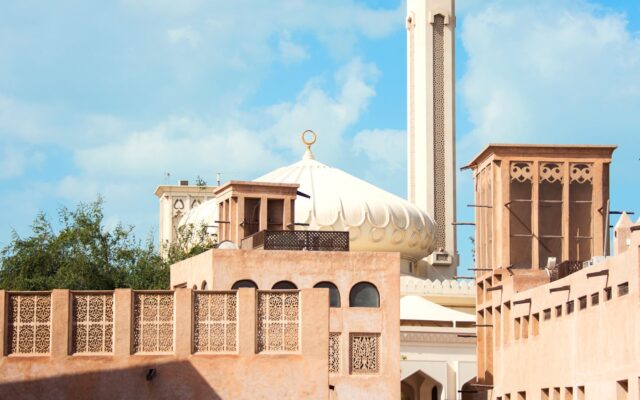
Two contrasting compositions complete the set. From an abra at dusk, the Grand Mosque in Bur Dubai offers the classic old-town shot — its tall minaret rising over rooftops and water, with Deira’s minarets answering across the Creek. Reflections, wooden boats and layered calls to prayer included at no extra cost.
For modernists, the DIFC Grand Mosque at Gate Avenue is a study in pattern and light: a contemporary cube whose geometric screen casts shifting shadows through the day and glows after dark. Pair it with DIFC’s glass towers for a frame that says everything about Dubai’s two aesthetics in a single image.
- Best hours: the first hour after sunrise and the last before sunset, plus blue hour for floodlit façades
- Best seasons: winter’s clear skies flatter stone and tile alike
- Kit tip: a wide lens for façades, a short telephoto for tile and dome details
- Respect rule: buildings yes, worshippers no — especially at prayer times and on Fridays
Photography With Manners
A few courtesies keep mosque photography welcome in Dubai. Dress modestly near mosques. Keep pavements and entrances clear. Do not fly assumptions — or drones — over prayer. If someone is in your frame at prayer, lower the camera; there will always be another sunset. And if you join the Jumeirah Mosque tour, follow the guide on where photography is permitted inside.
Handled this way, photographing Dubai’s mosques becomes more than image-hunting. You slow down. You learn the styles — Fatimid, Ottoman, Persian, vernacular, modern. You start timing your walks by golden light and prayer alike. The camera, in other words, teaches you to see the city the way its worshippers do: as a place where beauty and devotion were never separate things. Many photographers find their favourite Dubai images come not from the famous towers at all, but from these quieter façades, where patient craftsmanship, soft desert light and genuine community life meet in a single, unhurried frame that improves every time you return to it.