

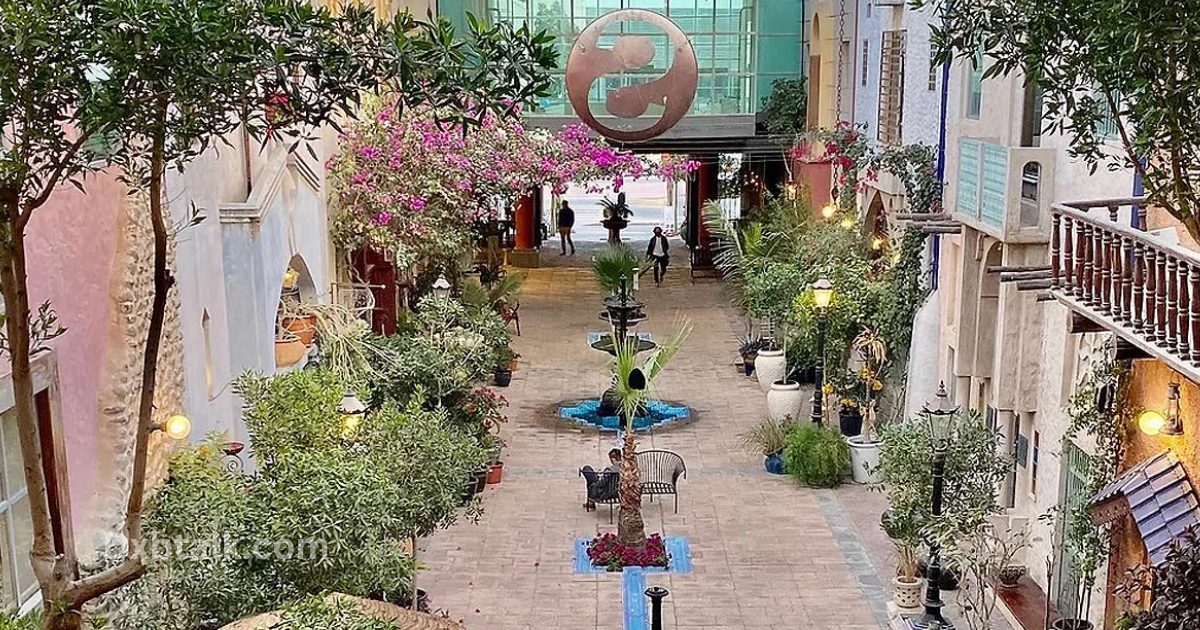
Al Quoz does not announce its architecture the way the rest of Dubai does — no spires, no superlatives. Its buildings reward a slower kind of looking: warehouse shells, gallery insertions, courtyards and one or two genuine set-pieces, all arranged along industrial streets. This is a walk through the district’s architectural highlights, and through the ideas — adaptive reuse, minimalism, design for community — that hold them together.
Alserkal Avenue: The Warehouse, Recomposed
The district’s architectural thesis statement is Alserkal Avenue, where a complex of industrial warehouses was transformed into contemporary art spaces without disguising what the buildings were. The design keeps the factory grammar intact — long spans, saw-tooth and flat roofs, roller doors, concrete and steel — and inserts gallery volumes, shaded lanes and a central yard inside it. The result is the definitive Dubai example of adaptive reuse: functionality and aesthetics in the same gesture, the building’s industrial memory doing half the atmospheric work that a new-build cultural centre would spend millions trying to fake.
The Yard: Where the Grid Softens
If Alserkal is the district’s hard edge, The Yard is its soft one — an open-air development where urban design is blended deliberately with natural elements: shops, cafés and art installations set among greenery, lawns and open space. Architecturally its interest lies in contrast. Against the enclosing warehouse walls elsewhere in Al Quoz, The Yard is porous and low, designed to promote lingering and social interaction rather than throughput — proof that the district’s design intelligence runs to landscape and community space, not only to converted sheds.
📸 Follow @dxbtalk1 on Instagram for daily Dubai in photos →
The Gallery Rooms: Minimalism as an Argument
Several of Al Quoz’s galleries are worth visiting for their shells alone. The Third Line’s space works in the modern gallery idiom — clean lines, minimalist surfaces, controlled light — an elegant, deliberately neutral architecture that throws every decision onto the artwork. Tashkeel takes the opposite brief: a creative hub whose design emphasises making, with studios, workshops and gallery under one roof, the building arranged around process and collaboration rather than display. Read together, the two express the district’s twin values — the artwork as object of contemplation, and the artwork as act of production — each given its correct architecture.
The Working Blocks: Functional Beauty
Concrete: The One True Set-Piece
Al Quoz has exactly one building that architecture tourists cross the world for, and it proves the district’s rule by exception. Concrete, on Alserkal Avenue, is a multi-disciplinary space designed by OMA — Rem Koolhaas’s practice — created by reconfiguring four existing warehouses into one flexible venue. Its exterior is sprayed with a dark, aggregate-flecked coating that makes the old shells read as a single sculpted mass; inside, vast movable walls reconfigure the volume for exhibitions, performances and fashion shows. It is the industrial warehouse elevated to high architecture without ceasing to be a warehouse — the district’s whole argument, executed by masters. Stand across the lane from it after walking the working blocks, and the spectrum of Al Quoz design, from the accidental to the authored, falls into a single view.
Finally, walk the Al Quoz Industrial Area itself, beyond the cultural cluster, and read the functional architecture on its own terms: warehouses, workshops and depots designed with practicality first — deep floor plates, high bays, durable materials — yet full of incidental invention, from improvised shading to signage to the sheer sculptural repetition of the grid. This is the substrate everything else grows from, and it demonstrates the district’s real architectural lesson: creativity in Al Quoz is not the opposite of industry. It is industry, paying attention to itself.
Visit in the late afternoon, when the low sun rakes across the warehouse elevations and the yards fill with the opening-night crowd, and the architecture explains itself without a guide: industry in the bones, art in the light, and a city learning — in this one district at least — to build its future out of its past.



Join the conversation