Somewhere in Dubai today, a car is driving itself through real traffic while its safety driver watches the road with their hands in their lap. That scene, science fiction a decade ago, is now a testing programme, and Dubai intends it to become the ordinary future of how this city moves. The emirate has set itself the ambition of being a global leader in autonomous transportation, and the pieces, vehicles, systems, trials, are visibly assembling. Here is a glimpse of the smart-transportation future Dubai is building, and what it will feel like to use it.
The Vehicles Themselves
The most visible layer is the cars. Dubai is testing autonomous vehicles across the city, with global manufacturers and local startups experimenting with self-driving technology on real roads, in real heat, dust and traffic, conditions that make the emirate a genuinely demanding testbed. A car that can drive itself through a Dubai summer, with its glare, its sand and its assertive lane-changers, can drive itself almost anywhere. Alongside the private car experiments runs the public fleet: autonomous buses and taxis are being trialled as affordable, accessible transport that requires no human driver, aimed squarely at the journeys most residents actually make, the station run, the school run, the last mile home.
The System Behind Them
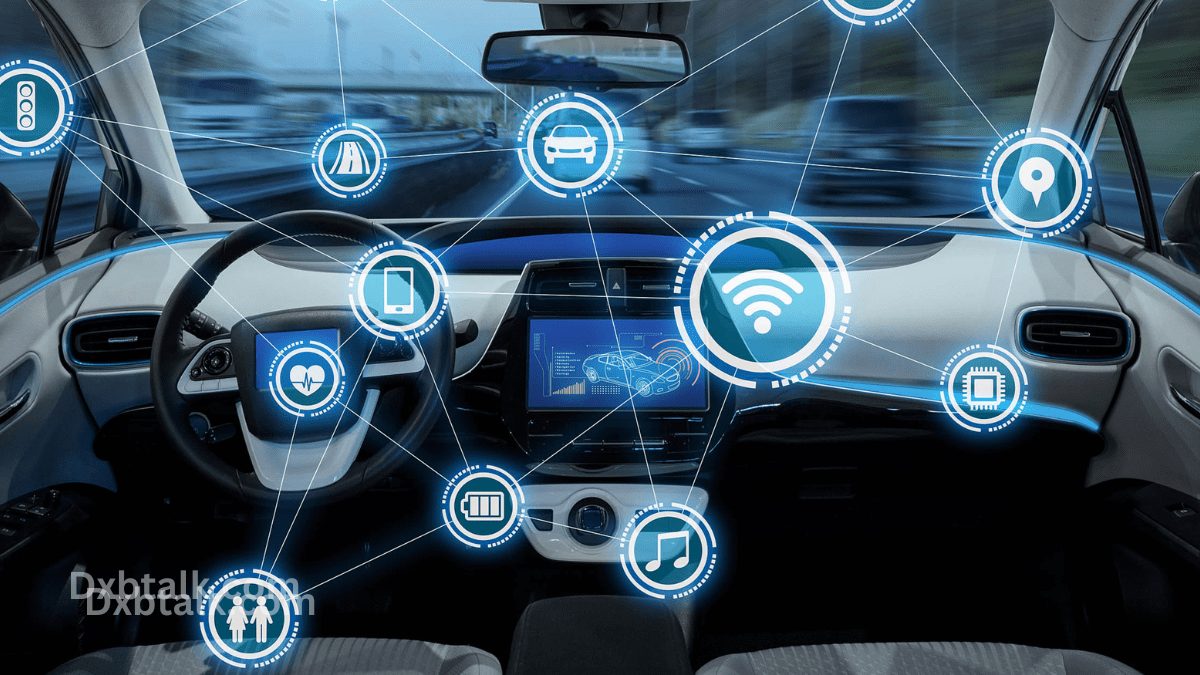
Self-driving cars alone are only half the idea. Dubai’s plans integrate autonomous vehicles with smart traffic management, systems that watch the network as a whole and tune lights, flows and routing in real time. The long-term picture is vehicles that communicate with each other and with the road itself, spacing themselves, merging cooperatively and smoothing the stop-start waves that human drivers create. Congestion in this vision is not merely endured by better cars; it is engineered down by coordination no human traffic stream can achieve. The city that built its reputation on spectacular infrastructure is applying the same instinct to invisible infrastructure: the choreography of movement itself.
📸 Follow @dxbtalk1 on Instagram for daily Dubai in photos →
What Changes for the Passenger
The promised benefits are practical before they are futuristic. Safety leads the list: the overwhelming majority of crashes are born from human error, distraction, fatigue, misjudgement, and removing that error from the system is the deepest argument for autonomous driving. Congestion follows, as coordinated vehicles use road space more efficiently and bottlenecks soften. And because autonomous fleets are typically electric, the shift compounds Dubai’s sustainability goals, cutting emissions and air pollution as the kilometres move from petrol to electrons. For the passenger, the strangest change will be the simplest: the journey becomes time returned. A commute that demanded your attention gives it back, to work, to family, to the city going past the window.
An Honest Sense of the Timeline
None of this arrives in a single unveiling. It arrives the Dubai way: trials widening district by district, services launching on defined routes, regulations maturing alongside the technology, the extraordinary becoming mundane one use case at a time, exactly as the driverless Metro did a generation ago. The direction, though, is not in doubt, because the city has organised itself around it at the level of strategy rather than experiment. The future of transport in Dubai is autonomous not as a slogan but as a programme: safer roads, smoother traffic and cleaner air, delivered by vehicles that are already, today, learning the city’s streets with their drivers’ hands in their laps.
What Stands Between the Trial and the Ordinary
An honest glimpse includes the obstacles. Regulation must decide how autonomous vehicles are licensed, insured and held responsible, in frameworks being built here as they are everywhere. The technology must prove itself not on the demonstration loop but in the worst hour of the worst day: the sandstorm, the flooded underpass, the chaotic school run. And the public must make its own judgement, the way it did with the driverless Metro, by riding, watching and gradually forgetting there was ever anything to judge. Dubai’s approach to all three is characteristically procedural: trial, measure, regulate, expand. The glimpse, then, is of a future arriving the way this city’s futures usually do: announced early, tested in public, and suddenly, one ordinary morning, simply how things are.