

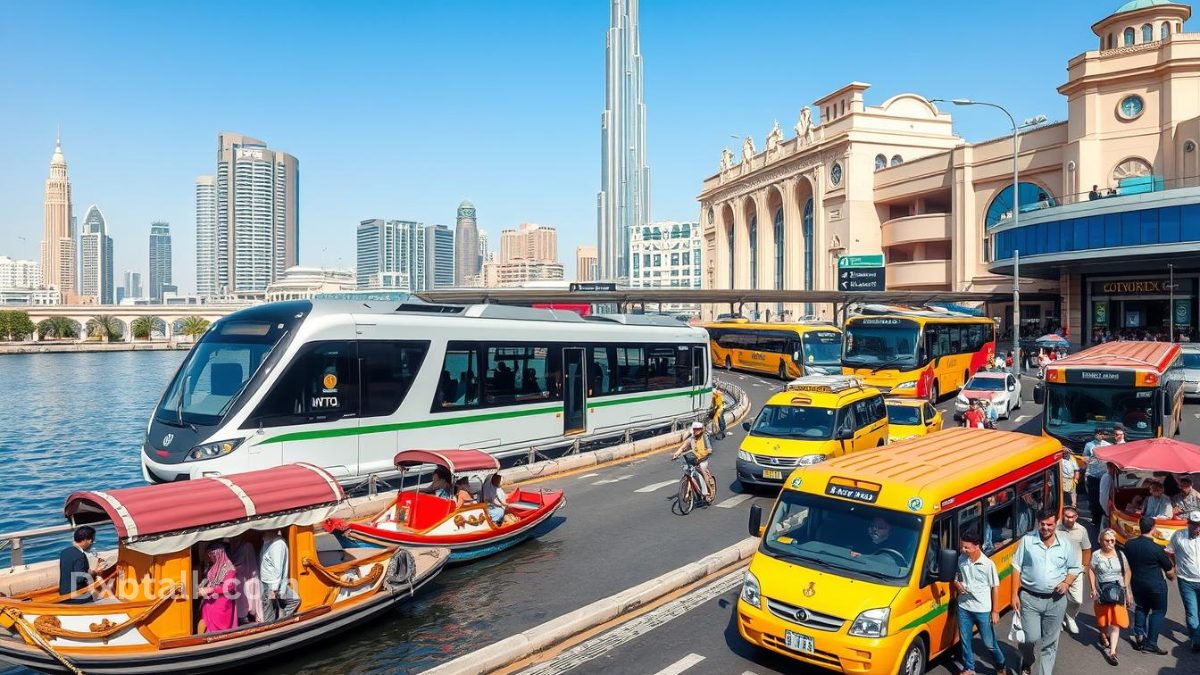
New arrivals in Dubai usually receive the same advice from the same taxi driver: you will need a car. It is the city’s oldest half-truth. Dubai has spent two decades building one of the most complete public transport systems in the region, Metro, buses, trams, water transport, all stitched together under the RTA and a single travel card, and residents who learn the system discover a city that moves at a fraction of the cost of driving it. This guide is the orientation: what exists, how it fits together, and how to navigate it with ease.
The Metro: Two Lines That Carry the City
Everything begins with the Dubai Metro, the driverless system whose Red and Green Lines connect the city’s major districts and landmarks: the airport and Deira on the Green Line’s side of the Creek, the length of Sheikh Zayed Road, Downtown, the Marina and beyond on the Red. Trains are frequent, stations are palatial by world standards, and the system’s great gift is certainty; a Metro journey takes the time it takes, indifferent to the traffic boiling beneath the viaduct. For the spine of almost any cross-city trip, it is the default answer, and the first thing a new resident should ride end to end just to learn the city’s geography from above.
Buses: The Network That Reaches Everything
Where the trains stop, the buses continue. Dubai’s bus network is extensive, over 1,500 buses covering most areas of the city, well-maintained, air-conditioned and organised around interchanges that feed the Metro stations. Buses are how the system reaches the villa districts, the industrial areas and the neighbourhood streets that no railway will ever serve, and for many residents the bus is not the backup plan but the daily reality: cheap, frequent on the main corridors, and planned properly through the RTA’s journey tools rather than guessed at the stop. A Metro-and-bus city is a complete city, and Dubai, quietly, is one.
📸 Follow @dxbtalk1 on Instagram for daily Dubai in photos →
Water Transport: The Oldest Layer
The system’s most charming layer predates all of it. Water taxis and the traditional abras cross Dubai Creek and serve the Marina and canal, carrying commuters and tourists on routes the city has used for generations. The abra crossing, a few minutes between Deira and Bur Dubai for a token fare, is simultaneously functioning transport and the best short journey in the emirate. Water transport will not organise your working week, but it belongs in any honest map of how Dubai moves, and visitors should ride it precisely because residents still do.
Why the System Wins
The benefits compound. Cost: public transport is genuinely affordable, priced as a public service, so a month of commuting costs a small fraction of car ownership, fuel, parking and Salik. Time: on dedicated infrastructure, the Metro in particular simply ignores peak-hour congestion, and regulars plan their days with a precision drivers cannot. Environment: every full train is a measurable subtraction from the city’s traffic and emissions, which is policy here, not accident; the system is one of the main instruments of Dubai’s sustainability goals. And there is the underrated benefit of attention: the passenger reads, works, watches the city, and arrives un-frazzled, while the driver arrives having spent the journey as unpaid labour.
Using It Like a Resident
Get the travel card, learn your two nearest stations and bus stops, plan journeys with the RTA’s tools until the network is in your head, and think in combinations: bus to Metro, Metro to abra, tram for the Marina loop. Dubai’s public transport rewards exactly that fluency, and it improves every year as lines extend and fleets modernise. The taxi driver’s advice was true of the city he learned to drive in. The city outside his window now has a system. Use it, and Dubai gets smaller, cheaper and calmer all at once.




Join the conversation