

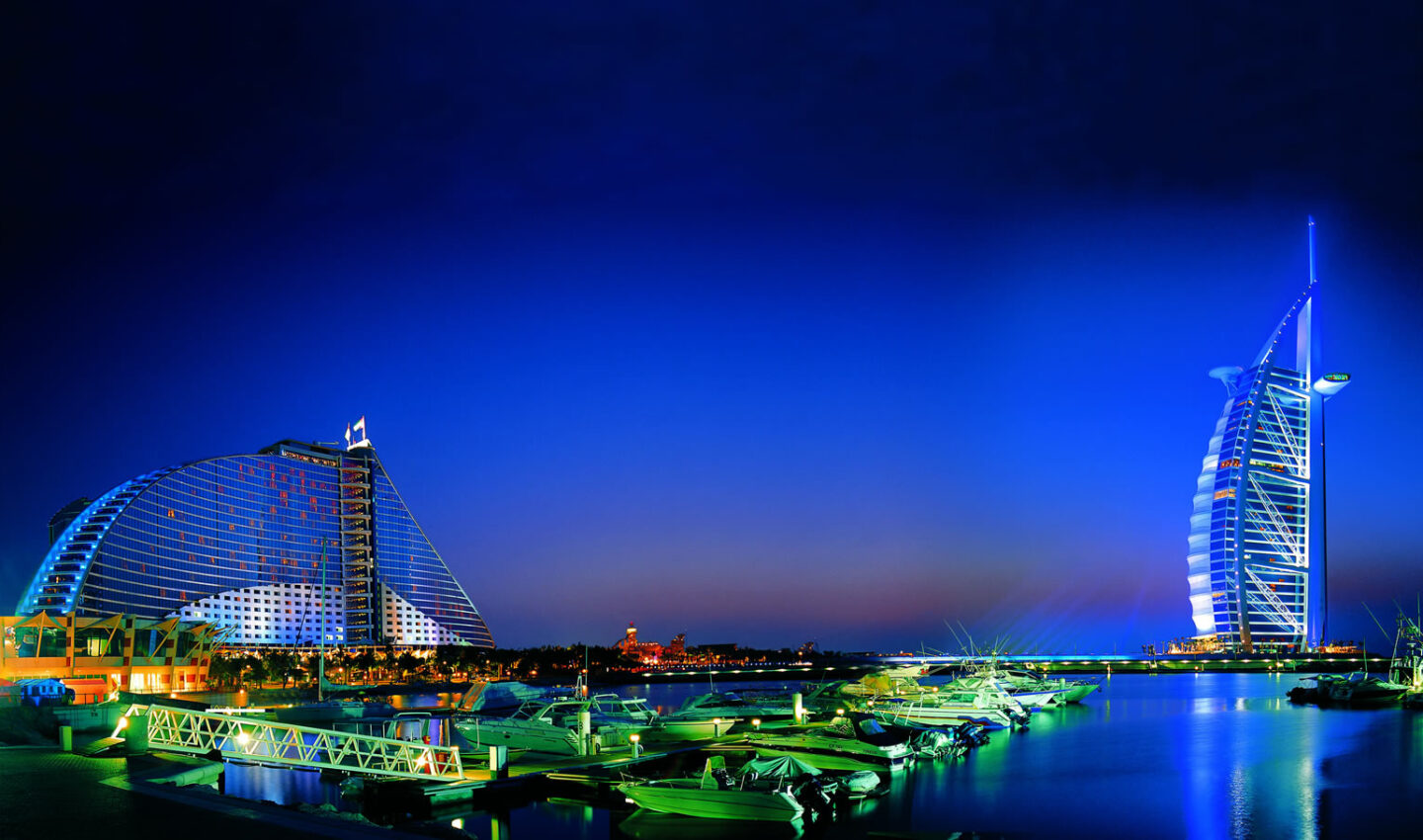
Before the Palm, before the Marina’s towers, there was Jumeirah: the original coastal strip where Dubai first learned to be a beach city. It still does the job differently from its younger rivals — lower-rise, leafier, more residential in feel, with the Gulf on one side and the city’s most famous hotel standing offshore like a full stop at the end of every view. This is the walk through it.
The Beaches Themselves
Start, as every Jumeirah day should, on the sand. Jumeirah Beach is the broad, golden stretch the district is built around — sunbathing space in real quantity, water sports on offer, and the practical comforts that make a beach day easy: sun loungers and umbrellas to rent, beach volleyball courts, and room for families to spread out rather than stack up. The water is the warm, gentle Gulf, the skyline views run in both directions, and the whole scene has a looseness the resort beaches deliberately lack. Next along the shore sits Kite Beach, the sporty sibling: kite surfers carving colour across the sky, a running track and promenade behind the sand, food trucks and a crowd that came to do something, not just to lie there.
The Icon Offshore
No exploration of Jumeirah escapes the Burj Al Arab, and none should try. The sail-shaped tower — often dubbed the world’s only seven-star hotel, a title it never officially claimed and never needed to — is the district’s anchor landmark, best appreciated from the beach it guards. You cannot simply walk in: the hotel admits booked guests, which turns its restaurants and its famous high tea into the legitimate ways inside. Book one, and the visit becomes a genuine experience rather than a photograph through glass. Until then, the exterior does fine — there is a reason it is the most recognisable silhouette in the country.
📸 Follow @dxbtalk1 on Instagram for daily Dubai in photos →
Eating and Drinking Along the Strip
Jumeirah’s culinary scene runs the full range in a few kilometres: casual cafés where the beach crowd refuels, seafood with the boats almost visible, and fine-dining rooms where the coastline is the decoration. The pattern to copy from residents is temporal — coffee and breakfast places in the morning, beach clubs and light lunches through the day, and the serious restaurants after the light changes. The district also does the evening social hour well, with lounges and terraces layered between the sand and the road.
Mercato Mall and the Slow Stroll
For the shopping chapter, Mercato Mall is the Jumeirah original: an Italian Renaissance-style mall on Jumeirah Beach Road in Jumeirah 1, open since 2002, with around 140 shops, a Spinneys supermarket, cinemas and cafes under one pastel, village-like roof. Town Centre Jumeirah sits right beside it for everyday errands. It is the natural hinge of a Jumeirah day: morning on the sand, lunch and browsing in the shade, back to the water for the golden hour. Build the day that way and the district explains itself without a guide.
A Resident’s Jumeirah
Live here a month and a second Jumeirah appears beneath the visitor’s one. It starts at dawn, when the Corniche belongs to runners and the sea to the early swimmers who treat the Gulf as a daily appointment. It runs on café regulars who have a usual table, on the small supermarkets and bakeries of the side streets, on the particular calm of a district that is low-rise by Dubai standards and intends to stay that way. Weekends have a choreography — beach early, long lunch, the promenade at golden hour — repeated by thousands of households who would not trade it for a taller view. The landmarks brought you here. This rhythm is what would keep you.
Getting There and Around
Jumeirah has no metro station of its own. The nearest Red Line stops are Mall of the Emirates, Financial Centre and Al Jafiliya, then a short taxi or bus ride down Jumeirah Beach Road or Al Wasl Road. Most residents drive: the district runs on those two roads, with the beach on one side and the villas behind it.
Why Jumeirah Endures
Newer districts offer more: taller, bigger, newer. Jumeirah offers proportion — a coastline you can walk, a beach culture that predates the mega-projects and outlasted them, and a landmark that still stops first-time visitors mid-sentence. It is Dubai’s coastal paradise in the oldest sense: the place the city goes to remember it lives beside a beautiful sea.






Join the conversation