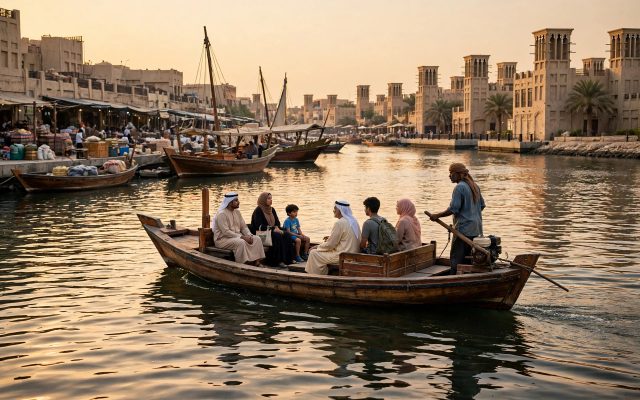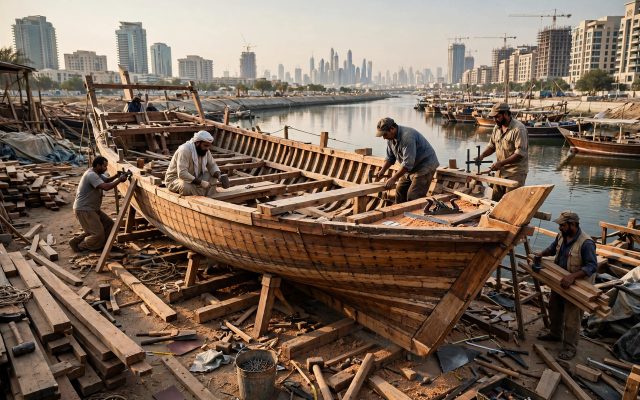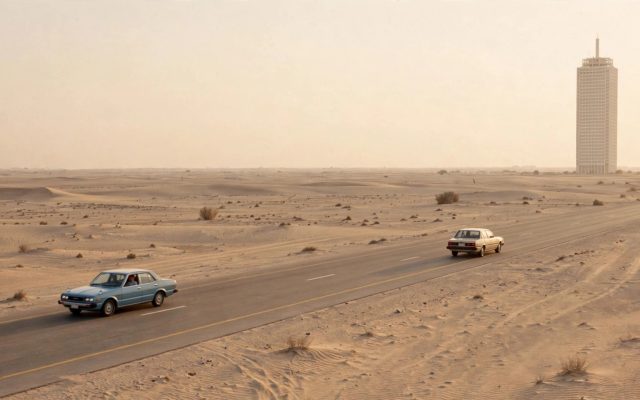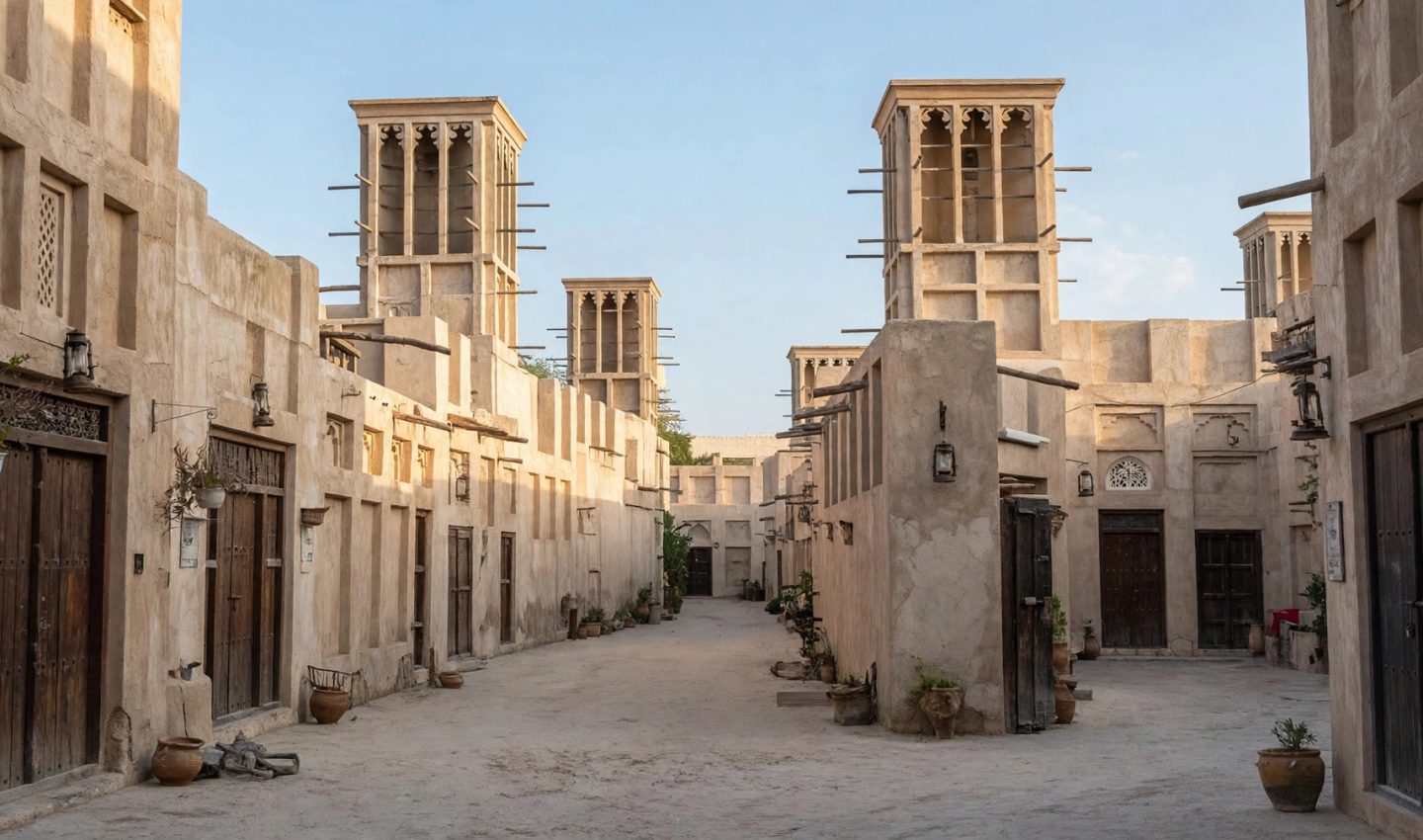
Walk through Al Fahidi on a still, hot afternoon and you will notice something odd about the old houses: many of them are crowned with square towers, open on all four sides, standing proud above the rooftops like chimneys that breathe. They are barjeel — wind towers — and for well over a century they were Dubai’s air conditioning. Long before compressors, condensers or a power grid, the merchants of the Creek cooled their homes with nothing more than moving air, gravity and good design.
How a Wind Tower Works
The principle is beautifully simple. The tower rises above the roofline, where the air moves faster and cleaner than it does at street level. Its four open faces catch the breeze from whichever direction it happens to blow, and internal dividers channel that air downwards into the room below. Because cool air sinks, the captured breeze drifts gently through the living space, while the tower’s shaded side can draw warm air up and out. The result is a house that feels noticeably fresher than the lane outside — no machinery, no fuel, no noise, just patience and physics.
The houses helped too. Walls of coral stone and gypsum, thick enough to slow the day’s heat, small windows, and rooms arranged around shaded courtyards all worked with the tower as one passive system. By the time the midday heat peaked, the interior had stored the relative cool of the morning; by evening, the sea breeze did the rest.
A Design That Crossed the Gulf
The barjeel is not originally Emirati — it came across the water from Persia, where windcatchers had cooled houses in desert cities for centuries. In the late nineteenth and early twentieth centuries, Persian merchants settled in growing numbers along the Creek, particularly in the quarter that became known as Bastakiya, named after Bastak in southern Iran. They brought their architecture with them: carved doors, decorative gypsum panels, and the tall towers that still define the Al Fahidi skyline today.
What they built was a hybrid — Persian technique adapted to local materials and a maritime climate. Coral rag, palm fronds, mud and gypsum replaced the brick of the Iranian plateau, and the towers grew into a symbol of status as much as comfort: a taller barjeel meant a wealthier household.
Free Dubai Tools
Dubai, in Your Hands
📸 Follow @dxbtalk1 on Instagram for daily Dubai in photos →
From Necessity to Icon
When electricity and then mechanical air conditioning arrived in the middle of the twentieth century, the wind tower’s working life quietly ended. New villas were built without them, and many old houses fell into disrepair. What saved the barjeel was heritage: the restoration of Al Fahidi preserved the towers as the district’s signature, and the design began appearing, in stylised form, on modern buildings, logos and souvenirs across the city.
There is a pleasing irony in that. Dubai, famous for engineering its way out of its climate, has kept the silhouette of its oldest cooling technology as a civic emblem. Architects still study the barjeel, because a tower that cools a room for free, forever, without a single watt, has never really gone out of date. You can see more of the city’s surprising firsts and records in our round-up of Dubai’s world records and remarkable facts.
Practical Notes
- Where to see them: the Al Fahidi Historical Neighbourhood in Bur Dubai has the finest concentration of original wind towers, all within a few walkable lanes.
- Best time to visit: go in the cooler morning or late afternoon; the lanes are largely pedestrian and there is little shade between houses.
- Look up: the towers reward a slow walk — count how many a single house carries, and notice the carved gypsum screens beneath them.
- Combine it: pair the walk with the Dubai Museum at Al Fahidi Fort and a coffee at one of the courtyard cafés in the quarter.
- Photography: the towers photograph best in low, angled sunlight, when the coral-stone walls turn warm and golden.
DXB FACT — DID YOU KNOW?
Snow in the middle of the desert
- Ski Dubaithe Middle East's first indoor ski resort
- Real snow22,500 m² of it
- Inside temperature−1°C to −4°C, all year
- Slopes5 — including an indoor black run
Source: The National
A new Dubai fact every dayRead more »
Reader poll
Poll of the Day
A fun reader poll, just for curiosity — not an official survey. A new question arrives every day.