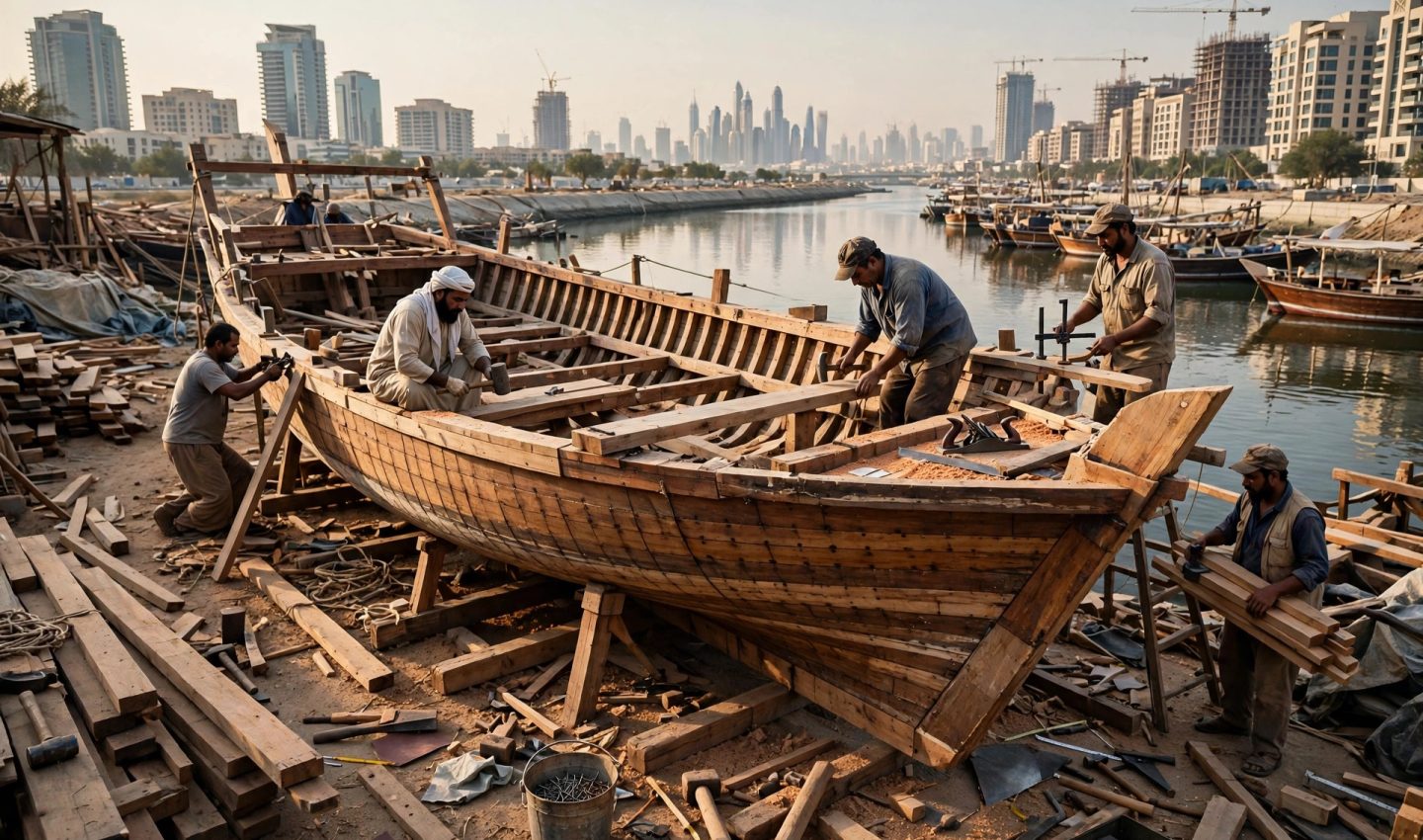
On the banks of Dubai Creek at Al Jaddaf, behind a plain fence and under open-sided sheds, men are building boats the way their grandfathers did — by eye, by hand, and largely from memory. The dhow yards of Jaddaf are among the last places in the Gulf where traditional wooden ships still take shape rib by rib, and the vessels launched here do not go to museums. They go to work, carrying cargo across the Gulf and the Arabian Sea to ports in Iran, India, Pakistan and East Africa.
A Craft Older Than the City Around It
Dhow building is the industry Dubai grew up on. Long before the port cranes and container terminals, the Creek was lined with yards turning out the wooden vessels that made the town a trading power — fishing boats, pearling boats, and the great ocean-going baghlahs and booms that sailed to India and Africa on the monsoon winds. The techniques were never written down in manuals. They passed from master craftsman to apprentice, in proportions judged by eye and corrections made by feel.
Al Jaddaf, whose name is associated with the boatbuilders’ craft, became the heart of the trade as the Creek developed. The yards there survived the fibreglass era and the container era alike, partly because wooden dhows still make economic sense on the routes they serve: they are cheap to build, cheap to repair in any small port, and shallow enough for harbours the big ships cannot use.
How a Dhow Takes Shape
A traditional build begins with the keel, laid on blocks in the open yard, and rises through steam-bent frames and planks of teak and other hardwoods fitted edge to edge. Historically the planks were stitched or nailed and the hull sealed with shark oil and lime; modern yards mix the old methods with power tools, fibreglass sheathing and diesel engines, but the hull forms remain recognisably ancient. A large trading dhow can take the better part of a year to complete, and the largest vessels built at Jaddaf are among the biggest wooden boats made anywhere in the world today.
The launch is the great occasion. With the hull complete, the boat is eased down the slipway into the Creek in front of a crowd of builders, owners and well-wishers — a ceremony that has changed little in a century, even if the dhow then motors away rather than raising a lateen sail.
Free Dubai Tools
Dubai, in Your Hands
📸 Follow @dxbtalk1 on Instagram for daily Dubai in photos →
Still Working, Still Sailing
Walk the Deira side of the Creek today and you will see the finished product at work: rows of wooden dhows moored along Baniyas Road, loaded with everything from tyres and textiles to refrigerators and spices, bound for ports their crews have traded with for generations. The Jaddaf yards keep that fleet alive, building new vessels and repairing old ones, and they also produce the smaller wooden abras and tourist boats that ply the Creek itself.
In a city celebrated for the new, the yards are a working link to the maritime economy that came first — and they sit only minutes from the glass towers of the modern Creek harbour. To understand what these boats mean to the city’s story, browse our collection of Dubai facts and heritage stories.
Practical Notes
- Where: the dhow-building yards line the Creek at Al Jaddaf, on the Bur Dubai side near the Culture Village development.
- Viewing: the yards are working businesses, not a visitor attraction — view from the waterfront paths and ask permission before entering or photographing craftsmen at work.
- Best experience: combine the yards with a walk along the Jaddaf waterfront promenade, which offers clear views of boats on the slipways.
- See the fleet: for the finished dhows in their element, walk Baniyas Road in Deira, where trading dhows load cargo along the wharves.
- Getting there: Al Jaddaf has its own Metro station on the Green Line, a short walk from the waterfront.
DXB FACT — DID YOU KNOW?
Snow in the middle of the desert
- Ski Dubaithe Middle East's first indoor ski resort
- Real snow22,500 m² of it
- Inside temperature−1°C to −4°C, all year
- Slopes5 — including an indoor black run
Source: The National
A new Dubai fact every dayRead more »
Reader poll
Poll of the Day
A fun reader poll, just for curiosity — not an official survey. A new question arrives every day.