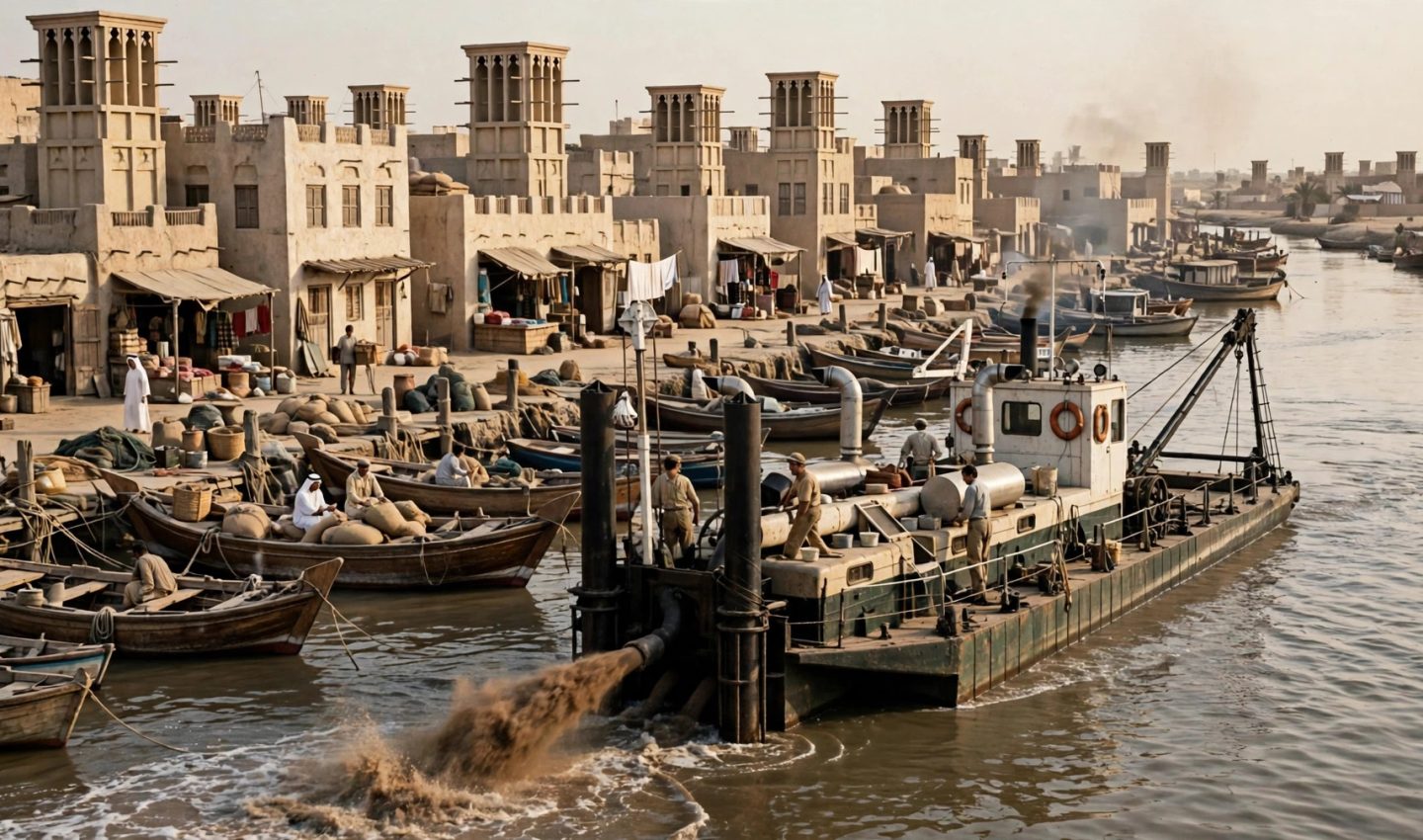
Every great port city has a founding decision, and Dubai’s was not a tower, a mall or an airport. It was a dredger. In the late 1950s, Dubai Creek — the saltwater inlet that had carried the town’s trade for centuries — was silting up so badly that larger boats could barely reach the wharves at high tide. Some voices suggested the struggling creek was finished. Sheikh Rashid bin Saeed Al Maktoum decided the opposite: he would dig it deeper, and bet the town’s future on the water.
A Creek Running Out of Water
To understand the stakes, remember what Dubai was then. The pearl trade had collapsed in the 1930s, oil had not yet been found, and the town lived on trade alone — dhows carrying goods between the Gulf, India and East Africa, merchants re-exporting through the souks of Deira and Bur Dubai. The Creek was not scenery; it was the entire economy. Yet nature was closing it down. Sand and silt built up at the mouth, the channel grew shallow, and boats increasingly had to wait for the tide or unload further out. Rival ports along the coast were happy to take the trade Dubai could not handle.
The Decision to Dig
Sheikh Rashid, who became ruler in 1958, treated the Creek as the project on which everything else depended. Beginning in the late 1950s and continuing into the early 1960s, the channel was dredged, deepened and widened, and the banks were strengthened with proper wharves. It was expensive, unglamorous work for a small town with limited income, and it was widely reported that the money was raised with help from merchants and regional support — an early example of Dubai financing infrastructure before the oil era made it easy.
📸 Follow @dxbtalk1 on Instagram for daily Dubai in photos →
What the Dredgers Bought
The effect was immediate and lasting. Deeper water meant bigger dhows and small cargo ships could berth directly at the wharves, load and unload faster, and keep Dubai at the centre of the region’s re-export trade. Merchants who might have drifted to other ports stayed. The gold trade, the textile trade and the general cargo business all grew on the back of a channel that worked. When oil revenue arrived later in the 1960s, it flowed into a trading city that was already functioning — the dredging is a large part of why there was a Dubai ready to spend it. The Creek was dredged and maintained repeatedly in the decades that followed, and the same instinct — deepen the water, welcome the ships — later produced Port Rashid and the giant Jebel Ali port further down the coast.
Free Dubai Tools
Dubai, in Your Hands
The Creek Today
Walk along Baniyas Road today and the scene is still working, not staged: abras ferry passengers across for a dirham, dhows load cargo bound for distant ports, and the old souks hum a few streets back. The waterway that was nearly given up on is now the historic heart of a city famous for looking forward. It is a useful reminder that Dubai’s story did not begin with superlatives. It began with maintenance — with a ruler deciding that a silting creek was worth saving, and being proved spectacularly right.
Practical Notes
- See it working: the Deira side of the Creek along Baniyas Road is the best place to watch dhows loading and abras crossing.
- Cross for a dirham: the traditional abra crossing between Deira and Bur Dubai costs around AED 1 and takes a few minutes.
- Visit the museum: Dubai Museum in Al Fahidi Fort covers the Creek’s trading and pearling history in an hour.
- Best light: late afternoon, when the water turns gold and the dhow traffic is at its busiest.
- Read more: our DXB Fact stories dig into more of the decisions and quirks that built this city.
DXB FACT — DID YOU KNOW?
Snow in the middle of the desert
- Ski Dubaithe Middle East's first indoor ski resort
- Real snow22,500 m² of it
- Inside temperature−1°C to −4°C, all year
- Slopes5 — including an indoor black run
Source: The National
A new Dubai fact every dayRead more »
Reader poll
Poll of the Day
A fun reader poll, just for curiosity — not an official survey. A new question arrives every day.