Dubai’s famous buildings were not built just to look good in photographs. Almost every landmark on the skyline was built to solve a problem, send a message or start an industry — a hotel shaped like a sail to announce a city to the world, a palm-shaped island to create coastline that did not exist, a frame built to hold the past and future in one view. Here are the real stories behind the icons.
Burj Khalifa: a downtown built around a tower
The world’s tallest building was never just a height record. It was the centrepiece of a plan to create a whole new downtown district — Downtown Dubai — and to shift the city’s economy further from oil towards tourism, finance and real estate. The tower’s footprint is based on the geometry of a desert flower, the hymenocallis, and its setbacks spiral so the structure sheds wind as it rises. Around it came the Dubai Mall, the fountain and the boulevard: the tower is the advertisement, the district is the business. It was also renamed at the last moment — originally Burj Dubai, it opened as Burj Khalifa in honour of the UAE’s president, reflecting Abu Dhabi’s support during the financial crisis years when the project was completed.
Burj Al Arab: the sail that sold a city
Before the Burj Khalifa, Dubai needed the world to notice it existed. The Burj Al Arab, opened in 1999 on its own artificial island, was built to be that billboard — a dhow sail rising from the Gulf, deliberately designed to become as recognisable as Sydney’s Opera House or Paris’s Eiffel Tower. Its famous “seven-star” label was never official; a journalist’s exaggeration stuck because the hotel encouraged the legend. Inside, it is all suites and no ordinary rooms, and its helipad has hosted publicity stunts from tennis matches to stunt jumps — every one of them calculated to keep Dubai’s name in global headlines.
📸 Follow @dxbtalk1 on Instagram for daily Dubai in photos →
Palm Jumeirah: building coastline from the sea
By the late 1990s Dubai faced a happy problem: its natural coastline was running out of room for beachfront development. The answer was to manufacture coastline. Palm Jumeirah was built from sand dredged from the Gulf and rock from the Hajar mountains, shaped into a palm tree — a design that multiplies beachfront: every villa on the fronds gets its own beach. It was an engineering statement as much as a property project, proving Dubai could physically expand itself, and it turned the city into shorthand for audacious construction worldwide.
Dubai Frame: the old city and the new in one picture
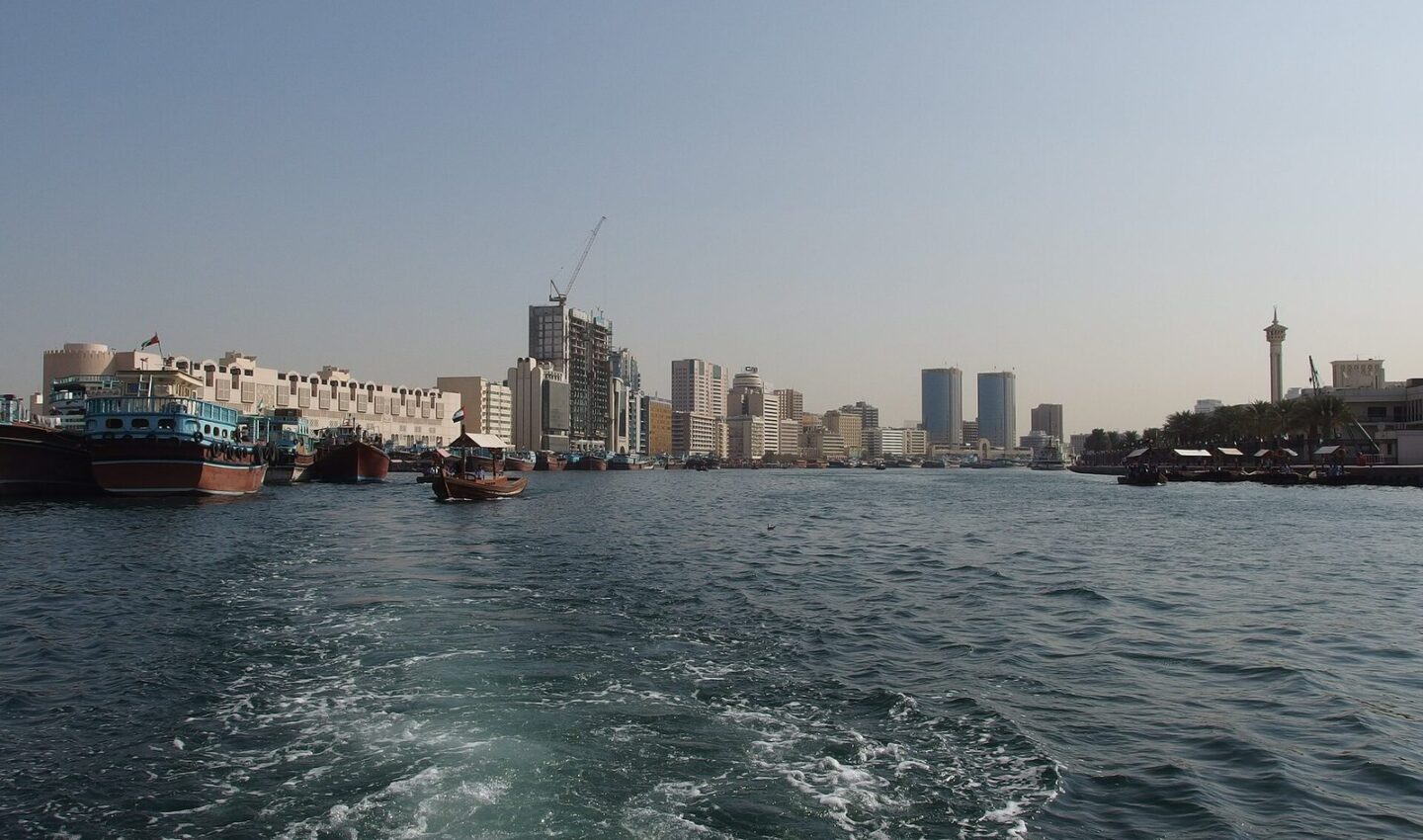
The giant golden frame in Zabeel Park, opened in 2018, is a deliberate piece of storytelling. Stand on its glass-floored sky bridge and look one way: Old Dubai, the Creek, Deira and Karama. Look the other: the Sheikh Zayed Road towers. The Frame was built to literalise the city’s favourite narrative about itself — a fishing port that became a futuristic metropolis within one lifetime — and to make visitors walk through that story, with a museum of the past below and a vision of the future above.
Museum of the Future: a building that is the exhibit
Most museums house objects; this one was built so the building itself demonstrates its theme. Its stainless-steel torus, covered in Arabic calligraphy quoting poetry about the future by Sheikh Mohammed bin Rashid Al Maktoum, has no internal columns — it was designed with advanced parametric tools and built with robotic assistance, technologies the museum exists to promote. It was positioned on Sheikh Zayed Road, deliberately in the traffic’s eyeline, as a permanent statement that the city’s next chapter is about innovation rather than size.
Atlantis, The Palm — and The Royal: tourism anchors
Atlantis at the Palm’s crescent was built to give the island a family-tourism engine: a waterpark, an aquarium and a resort large enough to fill the island’s hotels-and-headlines strategy. Its opening party in 2008 was famously extravagant, staged to announce that the Palm was a destination, not a construction site. Atlantis The Royal, opened more than a decade later next door, plays the same role for the ultra-luxury era — stacked, sky-bridged blocks designed to be photographed from the air.
Emirates Towers and the World Trade Centre: the business originals
Sheikh Zayed Road’s older landmarks tell the business story. The Dubai World Trade Centre, opened in 1979 when it was the tallest building in the region, was built to plug a trading port into the world’s exhibition circuit — it still appears on the 100-dirham note. The twin Emirates Towers, completed around 2000, anchored the financial district era, housing the offices (and one very famous office in the Emirates Office Tower) that signalled Dubai’s ambitions in regional finance long before DIFC existed.
Cayan Tower and the twisted race
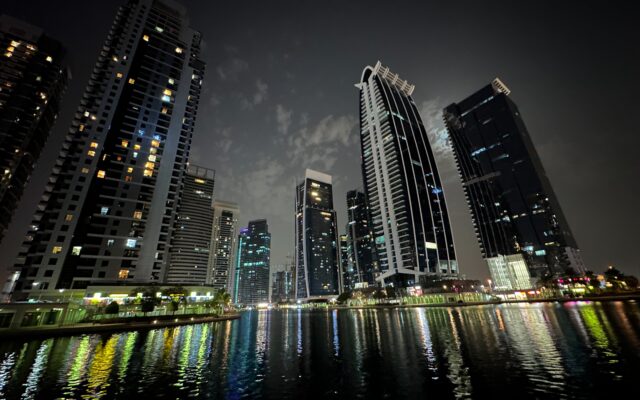
The Marina’s Cayan Tower twists a full 90 degrees from base to top. It was not twisted for pure vanity: the rotation gives more apartments water views and became a technical showcase for building skewed floor plates at height. It belongs to the 2000s boom generation of towers, when Dubai’s developers competed to give every tower a silhouette trick — sail, twist, picture frame — because a recognisable outline was marketing gold in a city adding hundreds of towers at once.
Why the stories rhyme
Look across the list and a pattern appears: Dubai’s famous buildings were instruments. Each was built to create a district, launch an industry, or make the world learn a young city’s name. That is why they look like logos — they were designed to work as ones. Next time you pass them, read them that way: not as decorations, but as the business plans of a city that built its way into the global imagination.