

Thinking about Palm Jumeirah? This guide looks at what living there is really like: the housing mix, how people get around, where they eat and shop, and who tends to be happiest there.
The area in short
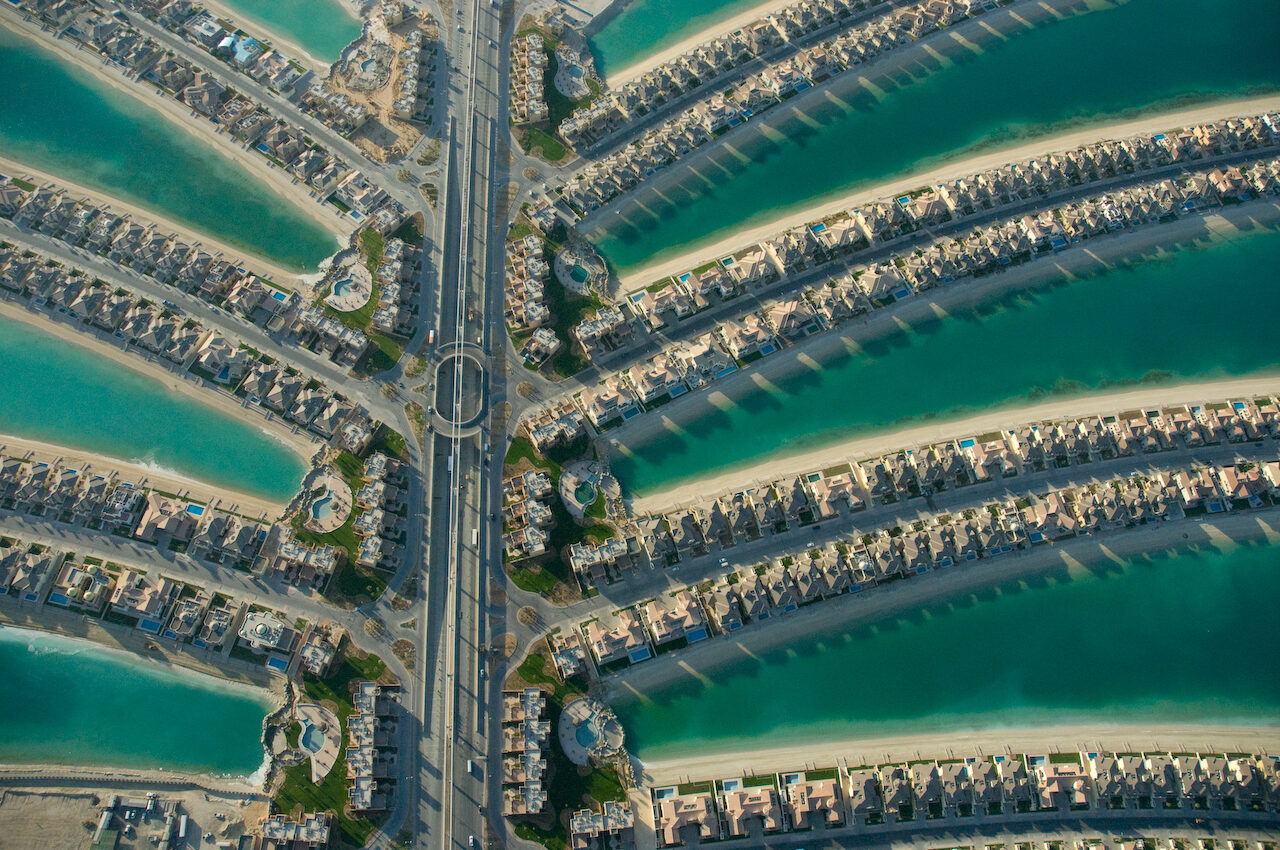
Palm Jumeirah is Dubai’s first man-made island, shaped like a palm tree and stretching 6.5 kilometres into the Gulf — an engineering landmark that added 78 kilometres to the city’s coastline. The island has three parts: the trunk, the social heart with apartments, malls and the monorail; the 16 fronds, gated villa communities where most homes have direct private beach access; and the crescent breakwater, home to the big resorts. It is one of the most expensive addresses in Dubai, and it suits people who want a permanent beach holiday.
The pros
Beach life is the default. Most villas on the fronds open straight onto a private beach, and the trunk’s apartments sit minutes from the sand. Palm West Beach, the 1.6-kilometre promenade on the trunk’s western side, has restaurants and beach clubs with views across to the Marina skyline and Ain Dubai. Atlantis Aquaventure, the world’s largest waterpark, is at the crescent’s tip.
Everything is on the island. Nakheel Mall, on the trunk, has more than 300 stores, a 15-screen cinema and dining across five levels; Golden Mile Galleria, beside Al Ittihad Park, is the everyday mall; and Waitrose and Spinneys cover groceries. The dining runs from casual beach clubs to Michelin-starred rooms — STAY by Yannick Alléno, with two stars, and Hakkasan — plus the restaurants of Club Vista Mare and Palm West Beach.
Private and secure. The fronds are gated communities with security at every entrance around the clock, and the island’s resort hotels — Atlantis, The Palm, Atlantis The Royal, One&Only The Palm, Fairmont The Palm — put five-star facilities within a short drive of home.
📸 Follow @dxbtalk1 on Instagram for daily Dubai in photos →
The cons
The Palm premium. Property, groceries and services all cost more here than inland — recent market data puts average prices around AED 2,200 to AED 2,500 per square foot, up more than 50% since 2020. Budget for it, or the island will strain the household budget.
One way in, one way out. The island relies on a single bridge for car access, and it bottlenecks at peak hours and on weekends when resort and beach-club visitors arrive. There is no direct metro: the Palm Monorail runs 5.5 kilometres down the trunk — Gateway, Golden Mile Galleria, Al Ittihad Park, Nakheel Mall, Atlantis — but it is owned by Nakheel, not the RTA, so Nol cards do not work on it and it is not part of the metro fare system. The Dubai Tram station at Palm Jumeirah connects the island to the Marina and the Red Line, but most residents still rely on a car or taxis.
Limited schools and green space. There is no full-scale school on the island itself, so families drive to schools in the surrounding districts. Al Ittihad Park is the main green space, and beyond it the island is beach, promenade and buildings rather than parks.
Sea air costs money. Salt air and humidity corrode building exteriors faster than inland, so seafront homes need more frequent maintenance — and ongoing construction and redevelopment on the island add noise and dust in places.
Getting around
Most residents drive: the single bridge connects to Sheikh Zayed Road, and the trunk road runs the length of the island. The monorail covers the trunk’s key stops for residents and visitors, the tram at Palm Jumeirah station links to the Marina and the metro, and buses and taxis fill the gaps. Plan car trips outside peak hours, and treat the monorail as a scenic way to reach Atlantis rather than a commuter line.
Eating out
The Palm eats at the top end of Dubai. Palm West Beach and Club Vista Mare gather the beachfront restaurants, the resort hotels host the fine dining — including STAY by Yannick Alléno and Hakkasan — and Nakheel Mall and Golden Mile Galleria carry the everyday cafes and restaurants. For the weekly shop, Waitrose and Spinneys are both on the island, at island prices.
Who it suits
The Palm suits people who will use the beach most days, want privacy and security, and are comfortable paying the premium and driving everywhere. It suits wealthy families in the frond villas and couples in the trunk apartments equally. It suits people less well if they need a metro at the door, a school on the island, or a low cost of living. If the sea is the point — and the budget allows — there is nowhere else in Dubai quite like it.




