Al Fahidi is where Dubai keeps its memory: wind-tower houses of coral stone and gypsum, narrow sikkas shaded from the sun, museums and coffee houses tucked into courtyards. Yet the historic quarter is no open-air museum that empties at night. People live here, work here — and pray here. The small prayer houses of Al Fahidi are the living thread that ties the oldest neighbourhood in Dubai to its present, five times a day.
They are easy to miss if you are only looking at rooftops. Look instead for a modest minaret above the wind towers, a doorway with shoes arranged in neat rows, or a sudden hush in a lane at prayer time. That is Al Fahidi at prayer.
Mosques Among the Wind Towers
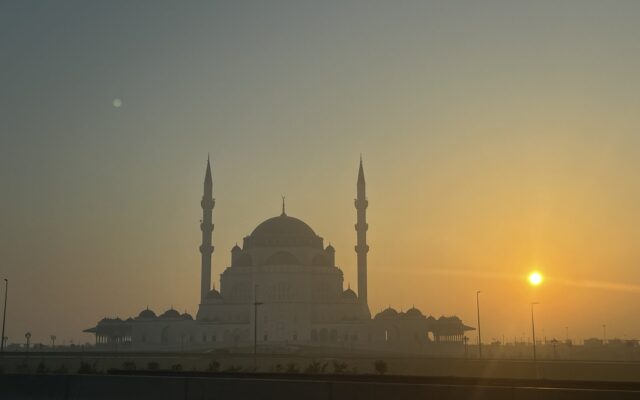
The neighbourhood’s mosques are scaled to the quarter itself: intimate rather than monumental, built to serve a few streets each. Their architecture speaks the local language — pale walls, simple arches, restrained decoration — sitting naturally beside the historic houses. In a district where the Grand Mosque’s tall minaret rises nearby, these smaller prayer houses handle the daily round, gathering residents and workers street by street.
That closeness gives them a special atmosphere. The same faces appear at Fajr and Isha. The imam greets half the congregation by name. A museum attendant, a café owner, an elderly resident whose family has lived in the quarter for decades — all share the same small hall, and the same strong sense that this place is theirs.
A Working Neighbourhood, Not Just a Heritage Site
It would be easy for Al Fahidi to become a stage set: heritage houses, tour groups, photographs. The mosques prevent that. Because the call to prayer still sounds over the sikkas and people still answer it, the quarter remains a neighbourhood first and an attraction second. Daily life is centred on prayer here in the most literal way — exhibitions open after Dhuhr, café regulars drift back from Asr, evening walks pause at Maghrib.
Prayer times change daily, so residents check the official UAE calendar or a prayer times app for the day. But in Al Fahidi the adhan is also simply part of the soundscape, drifting over courtyard walls and down the lanes to the Creek, exactly as it would have done when the quarter’s merchants came home from the dhows.
📸 Follow @dxbtalk1 on Instagram for daily Dubai in photos →
Old Streets, Many Nations
Al Fahidi’s congregation reflects both its history and its present. Emirati families with roots in the quarter pray beside the Arab, Iranian and South Asian workers who staff its museums, galleries and cafeterias, and beside newer residents drawn to old Dubai’s charm. In the small halls everyone is close — physically, in the shoulder-to-shoulder rows, and socially, in the greetings afterwards.
Fridays have their own flavour here. Jummah at the larger mosques nearby draws the whole Bur Dubai side, and afterwards families drift through Al Fahidi’s lanes towards lunch, the quarter at its most alive: art galleries on one side, grandfathers in white on the other, children running ahead between the wind towers.
Visiting With Respect
Al Fahidi’s prayer houses are for worshippers, and non-Muslim entry should not be assumed, as with most mosques in Dubai. Visitors are warmly welcome in the quarter itself — indeed, wandering it is one of the great pleasures of old Dubai — but give mosques their peace: keep lanes and doorways clear at prayer times, dress modestly, lower your voice nearby, and photograph the historic streets rather than people at prayer.
- Setting: wind-tower houses and sikkas of the Al Fahidi Historical Neighbourhood
- Character: small, intimate mosques serving a few streets each
- Nearby: Dubai Museum, the Grand Mosque and the Textile Souk
- Best time: early morning or late afternoon, ending at Maghrib by the Creek
Those who want a guided mosque interior should head to Jumeirah Mosque, where the Sheikh Mohammed Centre runs the Open Doors, Open Minds tours.
The Quarter’s Beating Heart
Heritage districts everywhere struggle with the same question: how to stay alive rather than merely preserved. Al Fahidi’s answer sounds five times a day from its minarets. As long as the prayer houses fill — with residents, workers and elders who have known these lanes all their lives — the old quarter is not a relic. It is a home.
Walk the sikkas at dusk, when the wind towers turn gold and the call to prayer floats towards the Creek. Behind one modest doorway, a small congregation is gathering in the cool hall. That quiet scene, repeated for generations, is the true historic monument of Al Fahidi.