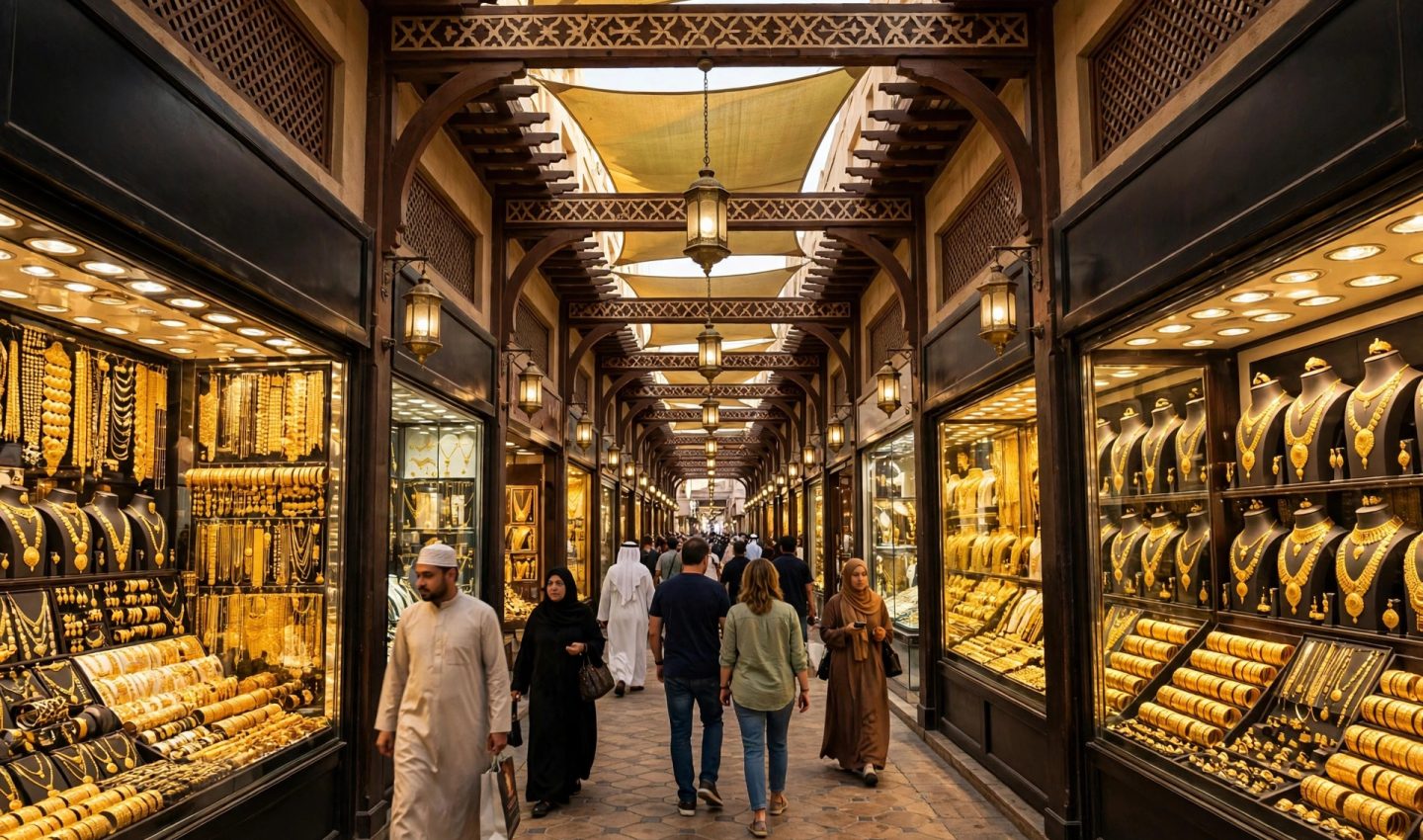
There is a moment, walking into the Gold Souk in Deira, when your eyes need a second to adjust — not to the dark, but to the light. Shop window after shop window blazes with gold: ropes of 24-karat chains, bridal sets heavy enough to need both hands, bangles stacked like scaffolding. This covered market near the Creek is one of the largest gold retail markets in the world, and it remains the single most dazzling bazaar in Dubai.
A Market Built on Trust
Dubai’s gold trade grew up with the Creek. Merchants from India and Iran settled in Deira generations ago, and gold — easy to carry, easy to value — became the cargo of choice. The souk’s arcade, with its wooden-beamed roof and rows of small shops, still runs on the old principles: reputation is everything, a trader’s word is his bond, and every shop’s scales sit in plain view of the customer.
What makes Dubai different from most gold markets is regulation. Every trader here is licensed, and the purity of what is sold is policed — the gold in the windows is what the stamp says it is. That trust is why families fly in from across the region to buy wedding gold in these lanes, and why the souk appears in our wider Dubai shopping guide as a place even nervous first-time buyers can shop with confidence.
How the Price Works
New visitors often expect gold prices to be a haggling free-for-all. They are not — and understanding that is the key to buying well. Gold jewellery here is priced by weight against the day’s international gold rate, which is displayed on electronic boards around the souk and in shop windows, updated as the market moves. The metal itself is therefore fixed: a gram of 24-karat costs what it costs everywhere in the city that day.
What you negotiate is the making charge — the workmanship fee added on top of the metal’s value. On a plain bangle the charge is small; on an intricate hand-worked bridal set it is significant, and that is where polite bargaining earns its keep. Ask each shop to break the price down into weight, rate and making charge before you discuss the total.
Free Dubai Tools
Dubai, in Your Hands
📸 Follow @dxbtalk1 on Instagram for daily Dubai in photos →
What to Look For
The windows mix the traditional and the modern: heavy Gulf and Indian bridal sets in 22-karat, delicate chains, diamond work, and souvenir-sized pieces for visitors. Keep an eye out for the souk’s famous giant — a ring recognised as the world’s largest gold ring, displayed in one of the windows and photographed by nearly everyone who passes. It is not for sale, sadly. Everything else is, and most shops will also buy or exchange old gold at the day’s rate.
Practical Notes
- Getting there: Al Ras station on the Green Line is a short walk; the abra across the Creek from Bur Dubai costs AED 1.
- Check the rate: look at the displayed gold rate before you enter a shop, so you can follow the maths on any quote.
- Haggle the right part: the metal price is fixed by weight — negotiate the making charge, and compare two or three shops for similar pieces.
- Keep the paperwork: take the invoice with weight and purity stamped; it matters for resale, exchange and customs.
- Timing: evenings are liveliest and the windows are at their most theatrical after dark; many shops pause in the early afternoon.
Come for a gram or come for a wedding — the Gold Souk treats both with the same seriousness, under the same extraordinary light.
DXB FACT — DID YOU KNOW?
Snow in the middle of the desert
- Ski Dubaithe Middle East's first indoor ski resort
- Real snow22,500 m² of it
- Inside temperature−1°C to −4°C, all year
- Slopes5 — including an indoor black run
Source: The National
A new Dubai fact every dayRead more »
Reader poll
Poll of the Day
A fun reader poll, just for curiosity — not an official survey. A new question arrives every day.