

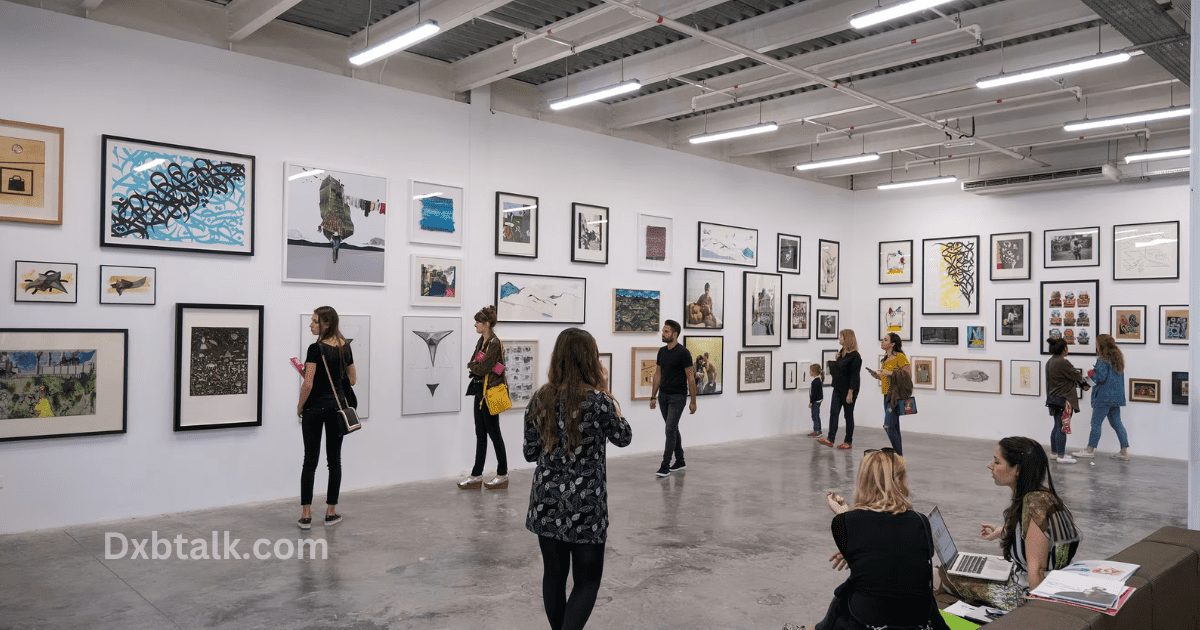
Twenty minutes from the towers of Sheikh Zayed Road, the most serious art conversation in the Gulf happens inside converted warehouses. Al Quoz — and above all Alserkal Avenue, its organised heart — holds a concentration of contemporary galleries that would flatter any world capital. This is a journey through the rooms that matter: what each gallery stands for, and how a visitor should read them.
Alserkal Avenue: The Frame Around Everything
Begin with the avenue itself, because it is the condition that makes the rest possible. A former marble factory and its neighbouring warehouses were converted into a cultural district of galleries, foundations, a cinema and cafés, run with a programmer’s intent: exhibitions are coordinated, openings cluster, and a single visit can carry you through a season of the region’s art. Everything below sits in its orbit — some on the avenue itself, others in the streets around it — and the avenue’s calendar, from art week to its late-night openings, is the rhythm the whole district breathes by.
The Third Line and Green Art Gallery: The Region’s Own Voice
The Third Line is the essential stop for contemporary Middle Eastern art. Its programme champions artists from the region across painting, photography, sculpture and installation, and its exhibitions are built as arguments — about identity, memory, displacement, home — rather than as decoration. Go expecting to be asked questions, and leave with the region’s art scene mapped in your head. Green Art Gallery works a complementary seam: a platform for contemporary voices, regional and international, with a strong curatorial hand and a habit of pairing exhibitions with talks and workshops that let audiences argue back. Between them, these two rooms explain why Dubai’s gallery scene is a participant in global contemporary art rather than a showroom for it.
📸 Follow @dxbtalk1 on Instagram for daily Dubai in photos →
Leila Heller Gallery: The Global Bridge
Leila Heller Gallery brings the other direction of traffic. With roots in New York and a programme spanning the Middle East and beyond, it shows established international names alongside regional artists, often at a scale — in both canvas and ambition — that the warehouse shell makes possible. For collectors it is a serious address; for the casual visitor it is the clearest demonstration that Al Quoz operates at world level, importing exhibitions that would headline elsewhere and exporting the region’s artists into the same conversation.
Tashkeel: Where the Artists Come From
How to Visit the Galleries Well
A few habits separate a good gallery day in Al Quoz from a bewildering one. Entry to the galleries is free, and the district rewards the unhurried: pick three or four rooms rather than twelve, and give each exhibition twenty real minutes. Saturdays carry the fullest energy, and the season’s peaks — art week in the spring, the big autumn openings, the after-dark Lates — are when the avenue becomes a street party of the art world. Talk to the staff: Al Quoz’s gallerists are famously willing to walk a curious visitor through an artist’s thinking, and a five-minute conversation will teach you more than the wall text. Finally, look at what is on the walls of the cafés and project spaces between the headline galleries — the district’s emerging names usually appear there first.
Every gallery scene needs a source, and in Al Quoz that source is Tashkeel. Artist-driven since its founding, it supports the development of local talent through studios, residencies, training and rotating exhibitions of work by the artists it nurtures. The tone is different from the white-cube rooms — processes visible, experiments allowed, practices mid-formation — and that is its value. If the other galleries show you where the region’s art is, Tashkeel shows you where it is going. A cultural journey through Al Quoz that skips it has read the conclusions and missed the draft. Taken together — avenue, advocates, bridge and source — these rooms make the district what it is: not a cluster of shops for pictures, but the working infrastructure of an art world.





