

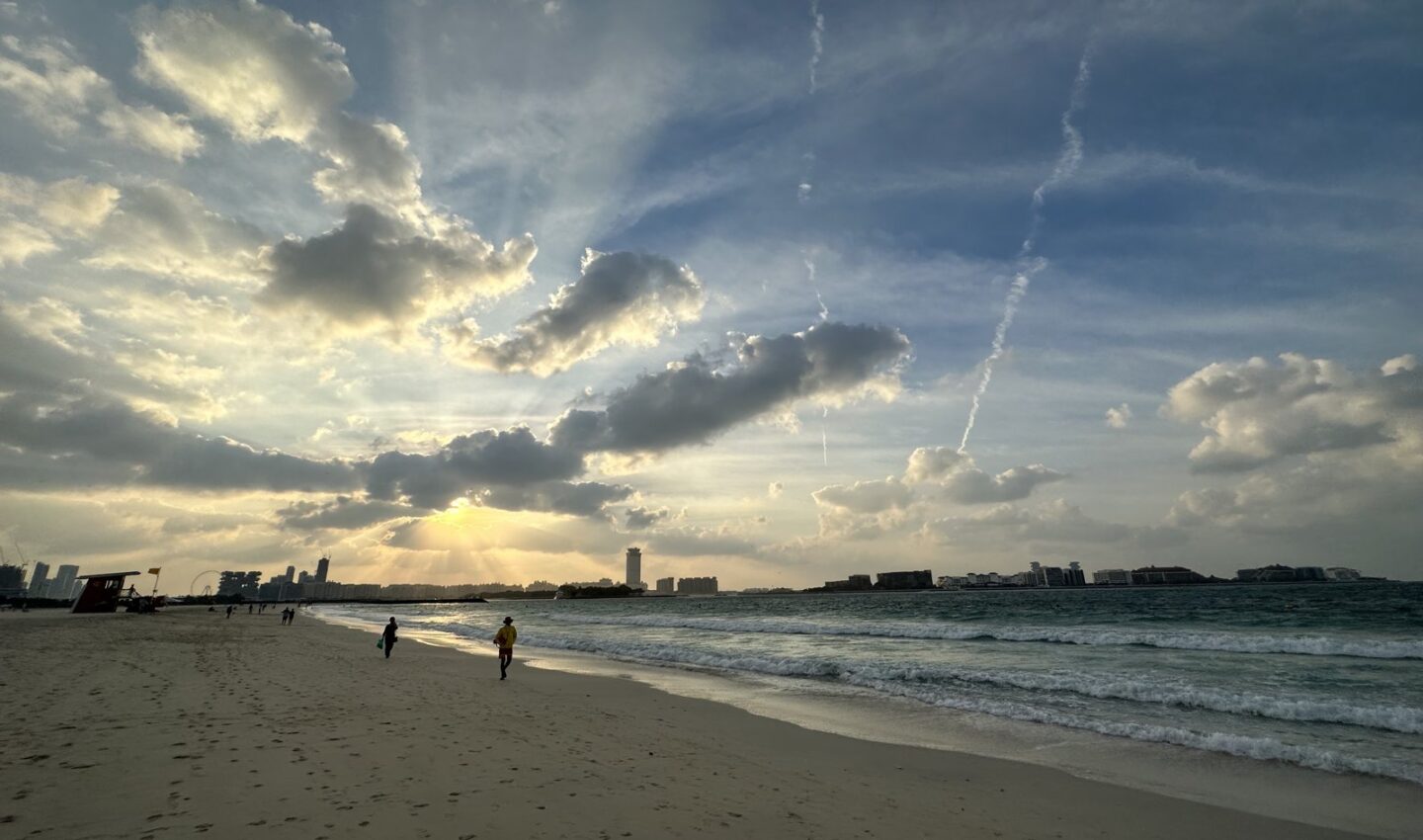
Every famous beach in Dubai announces itself: signage, cafés, music, a skyline at its back. The Al Sufouh shoreline does the opposite. Tucked along Al Sufouh Road between the Burj Al Arab and the base of Palm Jumeirah, this stretch of public beach — including the section long nicknamed Black Palace Beach, after the royal palace whose walls rise behind it — is easy to drive past and treasured by those who stop. On a winter morning it offers something the developed beaches cannot: near-silence, uninterrupted sand, and the feeling of having a piece of the Gulf to yourself.
Finding the Beach That Hides in Plain Sight
Part of Al Sufouh’s charm is that it has never been packaged. Access points sit along Al Sufouh Road, reached through gaps between the palaces and villas, with street parking nearby — in the early hours you will usually find space without a hunt. The beach itself is a long, gentle sweep of pale sand facing Palm Jumeirah, whose fronds and crescent fill the view across the water, with the Burj Al Arab standing guard to the south. There is no boardwalk and precious little infrastructure: no rental desks, no food trucks, and on much of the stretch, no showers or changing rooms. In winter that simplicity is the luxury. Dress for a walk and a sit rather than a full beach-club day, and the place makes complete sense.
The Morning Itself: Walk, Sit, Breathe
Regulars use Al Sufouh in unhurried ways. The sand is firm near the waterline at low tide, ideal for a long barefoot walk toward the Palm side and back. Anglers sometimes dot the quieter ends. Readers claim a patch of sand with a towel and a flask. Because the beach faces the Palm, the winter sun rises behind you and lights the water and the islands first — early on, the sea here is often the calmest in the city, a sheet of pale gold with the Atlantis skyline sitting on it in miniature. Photographers love the hour for exactly that composition: empty foreground, famous background, nobody wandering into the frame. It is also a fine place simply to watch Dubai wake at a distance — the city present in the view, absent in the ear.
📸 Follow @dxbtalk1 on Instagram for daily Dubai in photos →
About the Water: Honest Safety Notes
Simplicity cuts both ways, and it matters to be straight about it. Facilities and supervision vary along this stretch and are not comparable to flagship beaches like Kite Beach: you may find sections without lifeguards on duty or a flag system flying. So treat Al Sufouh as a walking, sitting and paddling beach first. If you want a proper swim, choose a moment and a spot where conditions are calm and other swimmers are present, stay close to shore and well within your depth — or better, save the swimming for one of Dubai’s designated, lifeguarded beaches and keep Al Sufouh for everything it does best. Never swim alone here, keep children within arm’s reach at the water’s edge, and leave the water at the first sign of currents or weather moving in.
What to Bring, Since Nothing Is Provided
- Water and coffee: There is nowhere to buy either on the sand; a flask is the regular’s essential.
- Shade: Winter mornings are kind, but by 10am the sun has strength — a hat, or a beach umbrella if you are staying.
- A mat or low chair: No loungers for hire; the sand is your furniture.
- Sun protection: The breeze makes winter sun deceptive; apply it before you settle in.
- A bag for your rubbish: The beach stays beautiful because its visitors carry everything out.
When to Go and How to Leave It
The sweet spot is the first two hours after sunrise, roughly seven to nine in mid-winter, when the light is softest, the sea flattest and the sand emptiest. Weekday mornings are quieter still. As with all of Dubai’s public beaches, swimwear belongs on the sand — cover up when you head back to the street — and the palaces behind the beach ask for the obvious respect: no wandering onto private property, no drones, keep noise low. Do that, and Black Palace and Al Sufouh will keep giving Dubai the one thing its famous beaches no longer can: a winter morning where the loudest sound is the water.





