Dubai’s skyline is famous for a reason, but its architecture tells a richer story than height alone. Read properly, the city’s buildings are its biography — a trading port that learned to cool itself with wind, then reached for the sky with glass. For visitors, architecture is one of the easiest pleasures in Dubai: much of it can be enjoyed simply by looking up, and by walking slowly.
The Modern Icons
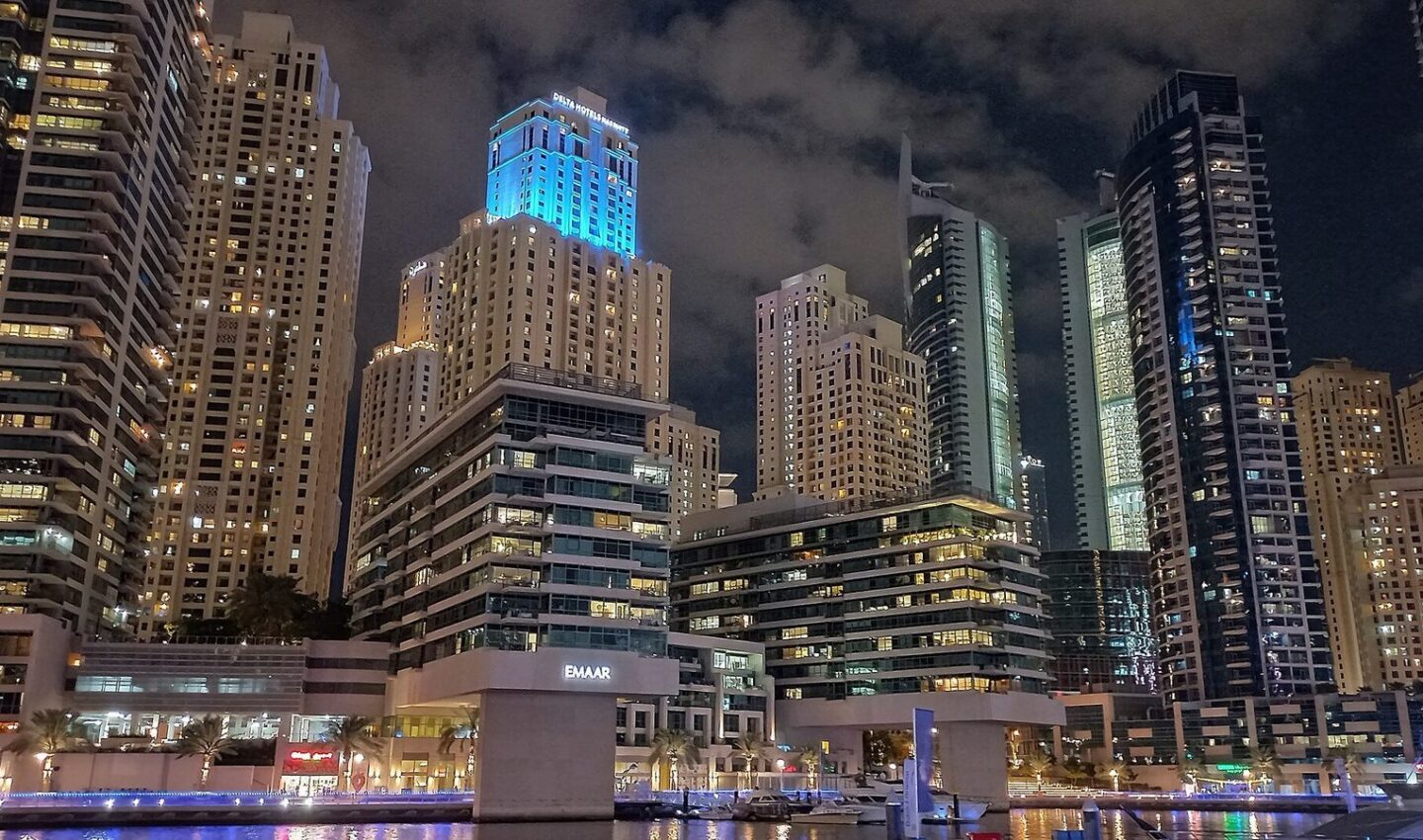
Start with the giants. The Burj Khalifa tapers into the sky from downtown; the Burj Al Arab rises from its own island shaped like a sail under strain. Their forms — twisting, tapering, sail-like — are not merely decorative. In a desert city, shape is strategy: towers are sculpted to shed wind, dodge the worst of the sun, and throw shade where people walk. The same building rewards repeat viewing. At noon it is sleek and silver; at sunset it turns dramatic; from an observation deck you read the city as a map, and from a waterfront promenade you read the towers as a fleet. Viewing from different angles and different hours is not repetition — it is the exhibit changing.
The Old Architecture of Climate
Then cross the Creek into the older city, where the architecture runs the opposite way: low, thick-walled, and ingenious. In the Al Fahidi quarter, wind towers rise above courtyard houses built to pull breezes down into shaded rooms centuries before air conditioning. Mosques carry the classical vocabulary of domes, minarets and geometry — the Jumeirah Mosque, open to visitors on guided tours, is the graceful introduction. The souks and waterfront warehouses show how a trading port was actually built: practical, dense, and arranged around the water that fed it. Museums here often make the building itself part of the exhibit, and rightly so.
📸 Follow @dxbtalk1 on Instagram for daily Dubai in photos →
How to Look
You do not need an architecture degree; you need a route and a pace. Walk a path that mixes old and new in a single day, so the contrast tells the story — wind tower in the morning, observation deck at dusk. Look at details as well as skylines: the screens that filter sunlight into pattern, the shaded walkways, the materials chosen because they forgive the climate. Go early or late for the best light and the best photographs, and spend time at street level, where you can see how people actually use these buildings — the café spilling from an arcade, the majlis cool behind a screen.
Why It Stays With You
Architecture in Dubai is not a backdrop. It is a living record of the city’s past, present and ambitions — coral stone at one end of the Creek, the tallest tower on Earth at the other, and a straight line of intent connecting them. Give it a day of looking, and the skyline never quite flattens into a postcard again.
The Buildings In Between
Between the wind towers and the supertalls sits a third Dubai, easy to overlook and worth a look. The Dubai Frame rises over Zabeel Park as exactly what its name promises — a colossal golden picture frame through which the old city and the new align in a single view. On Sheikh Zayed Road, the Museum of the Future wraps its exhibition halls in a torus of Arabic calligraphy, a building that is also a text. Even the metro stations, with their shell-like roofs, and the great malls — several of which are serious works of architecture wearing retail as a disguise — belong to the story. Dubai builds its everyday structures with the same restlessness as its monuments, and the visitor who notices them understands the city a level deeper.
A final suggestion: return to one building twice. See the great tower in the morning glare and again when the city lights take over; cross the Creek by abra at noon and at dusk. Dubai’s architecture is designed for a sun that changes everything by the hour, and the second look is where casual visitors become genuine admirers. The city rewards those who look up — and then look again.
Related Guides
- Discover Dubai’s Iconic Landmarks from the Water: Must-See Boat Tours
- Quasi exercitationem adipisci architecto vitae provi