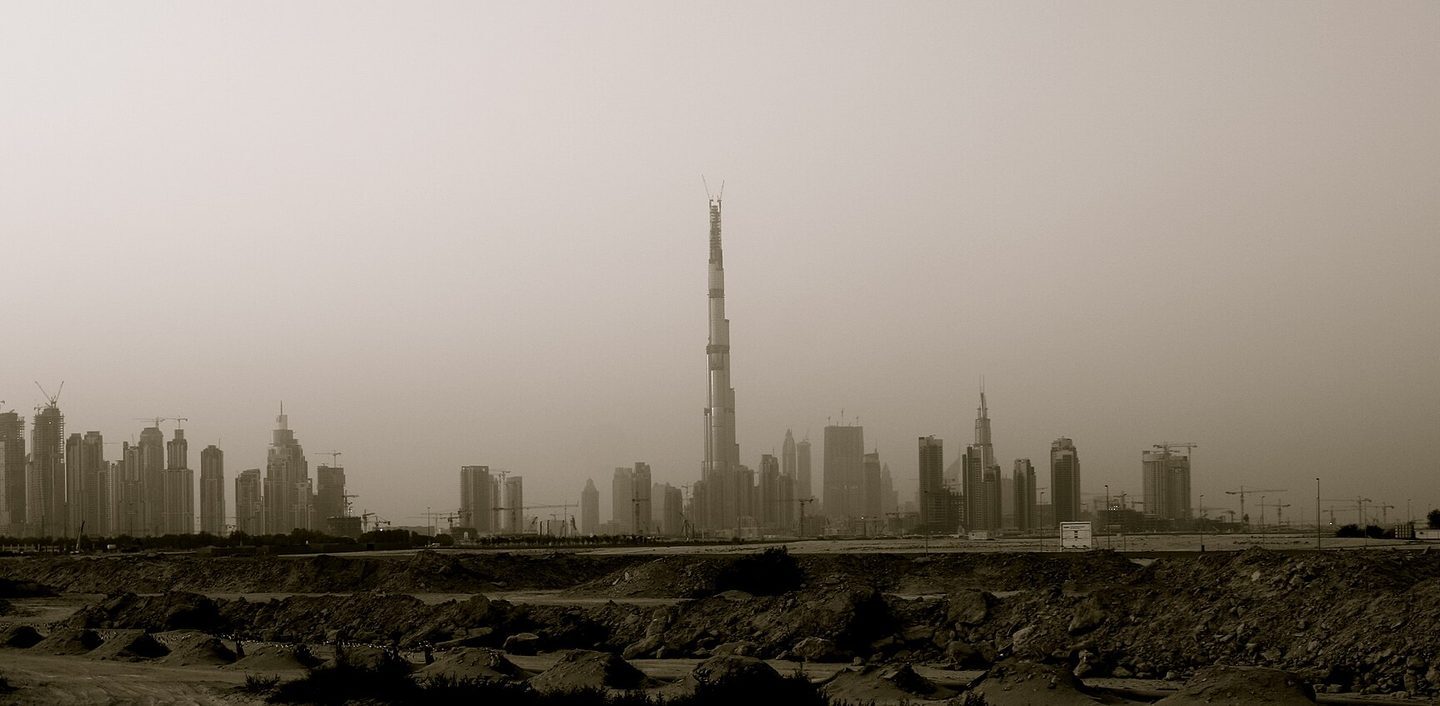
Dubai began as a waterfront and never really stopped being one. Every era of the city has built its own version of the water’s edge — the trading creek, the marina, the canal, the island crescents — and visiting them in sequence is the fastest way to read the whole biography. Each waterfront has a distinct character and a distinct best use. Here is the map, from oldest water to newest.
The Creek: Where the City Is Still Its First Self
The historic waterfront is Dubai Creek, the inlet that made the city a port. Its banks carry the oldest Dubai: the merchant houses and wind towers of Al Fahidi and Shindagha on the Bur Dubai side, the souks and the dhow wharves on the Deira side, and between them the abras — the little wooden ferries that have crossed this water for generations and still do, all day, for everyone. Al Seef has dressed the Bur Dubai bank in heritage style, with cafés and shops in old-city dress along a long, walkable shore. Come here for the city’s soul rather than its spectacle: ride the abra, eat by the water in a district that has fed traders for a century, and watch the cargo dhows still loading downstream. Evenings, when the heat lifts and both banks light up, are the Creek at its best.
Festival City and the Canal: The Designed Generation
The Creek’s upper reaches show the next chapter. Dubai Festival City wraps a crescent of the water in a mall, hotels and a promenade whose evening centrepiece is a light, water and fire show played across the bay — a planned waterfront that performs on schedule and draws families accordingly. Further into the city, the Dubai Water Canal cuts a younger, more sculptural line: a boardwalk of bridges and viewpoints, the waterfall cascading from the Sheikh Zayed Road crossing, Business Bay’s towers arranged along the banks. This is the waterfront as urban design — jogging routes and sunset photography, quieter than the coast, and best at golden hour when the skyline turns the water copper.
📸 Follow @dxbtalk1 on Instagram for daily Dubai in photos →
The Marina and JBR: The Cosmopolitan Shore
Dubai Marina is the waterfront the world pictures: a hand-dug harbour ringed by towers, a promenade of restaurants and yacht berths, and an evening energy that runs from family strolls to dinner cruises. Its continuation at JBR’s The Beach and the bridge to Bluewaters Island loosens the formula — open sea on one side, beach clubs and dining on the other, the great observation wheel turning over the whole scene. These are the city’s social waterfronts: come for dinner with a view, a boat trip out of the marina, or simply the finest people-watching promenade in the emirates, and time it for after dark, when both shores are fully lit and the water is black glass.
The Palm and the Open Beaches: The Resort Coast
The Palm Jumeirah contributes the engineered sublime: a crescent boardwalk facing the skyline across open water, resort beaches, and views back at the city that no natural coastline could have arranged. Beyond the developments, the public beaches — Kite Beach and the Jumeirah shore, the surf and swim spots toward the city’s quieter ends — are the waterfront in its simplest form: sand, lifeguards, a running track, food trucks, and the sea doing the entertaining. Public beaches are free and well kept; private beach clubs sell the serviced version, with cabanas and menus, for a day rate. Observe the safety flags and swimming guidance wherever you enter the water, and respect the dress and behaviour norms that keep public beaches comfortable for everyone.
Choosing Your Waterfront
Match the water to the day. Heritage and atmosphere: the Creek, slowly, with an abra crossing and an old-town dinner. A family evening with a show: Festival City. Design and a golden-hour walk: the Canal. Energy, dining and the postcard: the Marina into JBR and Bluewaters. A beach day plain and simple: the public coast, early or late in the day, with the heat planned around rather than endured. Practical threads run through all of them — evenings beat middays almost everywhere, parking at the famous spots fills fast so public transport earns its keep, and a waterfront visit pairs naturally with dinner to make a complete evening of it. Dubai has built a dozen different answers to the same question of how a city meets its water. The pleasure is that you do not have to choose just one — only the order.