

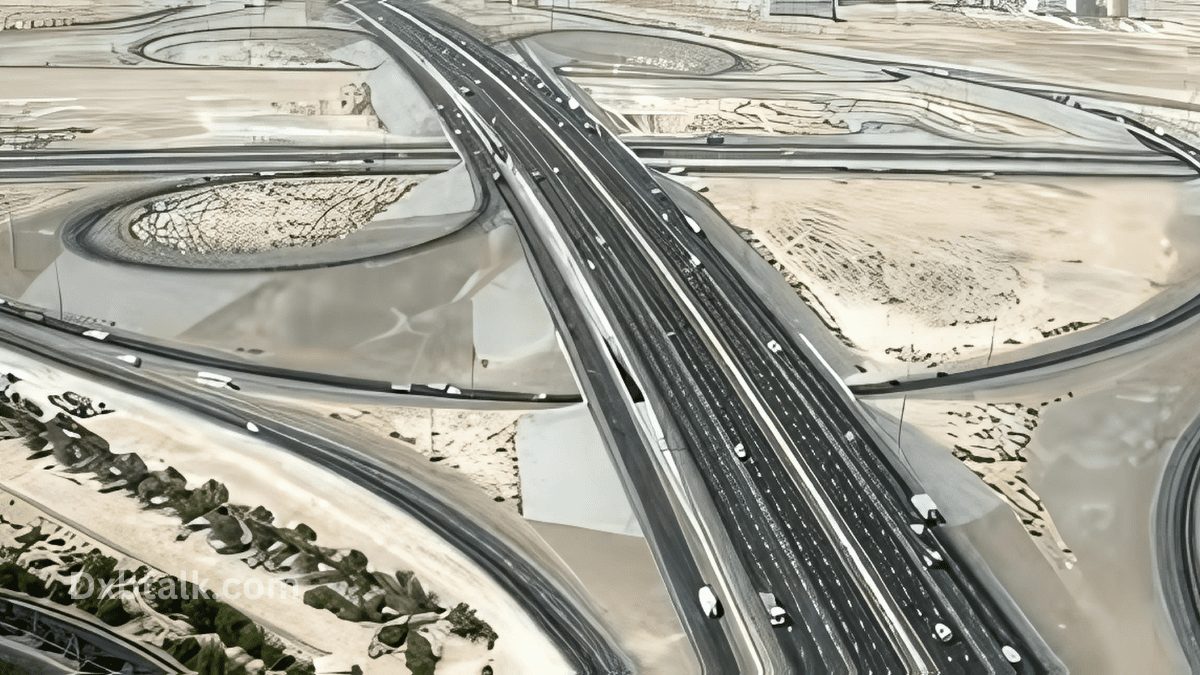
Dubai drives fast and thinks of itself as driving safely, and the interesting thing is that both reputations are substantially engineered. The emirate’s roads are not wide by accident or policed by whim; they are the product of deliberate design choices, generous geometry, managed flow, layered enforcement, made by a city that decided its road network was national infrastructure in the same class as its ports and airports. This is how Dubai’s roads and highways are built to hold speed and safety in the same hand.
Geometry First: Width, Flow and Forgiveness
Start with the physical facts. Dubai’s main highways are exceptionally wide, multiple lanes in each direction, well-surfaced and maintained to a standard that removes the road itself as a variable in most journeys. Interchanges are built at scale, with long merging lanes and clear sightlines, because engineers here design for flow at volume rather than merely for capacity on paper. The arterial hierarchy does quiet safety work too: Sheikh Zayed Road, Emirates Road and Sheikh Mohammed Bin Zayed Road carry the long-distance load, the Dubai–Sharjah corridor absorbs the northern commute, and local distributors feed them in order, so that through-traffic and neighbourhood traffic are not fighting in the same space. Wide, legible, forgiving roads do not excuse bad driving; they ensure that ordinary driving stays ordinary even at the city’s pace.
The Managed Layer: Traffic as a System
Above the asphalt sits the management layer that makes Dubai’s network a system rather than a pile of roads. Smart traffic signals coordinate corridors rather than junctions, control centres monitor flow across the network through cameras and sensors, and congestion is treated as data before it becomes gridlock, with incidents detected, responses dispatched and information pushed to drivers while there is still a choice of route. This is the part of road engineering visitors never notice and residents benefit from daily: a city actively operating its roads in real time, the same philosophy that runs its Metro and its airports applied to the tarmac.
📸 Follow @dxbtalk1 on Instagram for daily Dubai in photos →
Enforcement: The Camera as Infrastructure
Safety in Dubai is enforced with the same seriousness as it is designed. Speed limits are strict, clearly signed and backed by one of the world’s most extensive radar camera networks, fixed and mobile, monitoring the highways and, increasingly, the behaviour around them, from lane discipline to phone use. The theory is deterrence by certainty rather than by severity of surprise: drivers moderate their speed because detection is assumed, and the data shows in the flow, high speeds held inside an envelope the system can manage. Link this to the licensing and vehicle-testing regime and the pattern completes itself. The road is engineered, the traffic is managed, the rules are watched, and the driver operates inside all three layers at once.
The Pedestrian Layer, Catching Up on Purpose
The newest layer of the engineering is the one on foot. Dubai has been retrofitting humanity into a car-scaled city: clearly marked crossings, signalised junctions, and a growing network of pedestrian bridges lifting people over the great roads safely, with the newer districts designed from the start around walkable, shaded movement rather than having it apologised in later. It is the least finished part of the project and the most telling: a road system confident enough in its vehicle engineering to spend its next decade on the people outside the vehicles.
The Result, and Its Honest Limits
Put the layers together and the emirate’s driving proposition comes into focus: roads built generously, traffic managed intelligently, rules enforced relentlessly, and a system still investing in its weakest layer. The honest engineer adds the caveat: infrastructure sets the stage, but the actor is still the driver, and Dubai’s remaining road tragedies are overwhelmingly behavioural, speed chosen, phones lifted, distances ignored. The city has engineered everything it can around that fact. What happens inside the car, at the speed the road allows and the cameras watch, remains, as it is everywhere on earth, a human decision made a hundred times a journey.




Join the conversation