

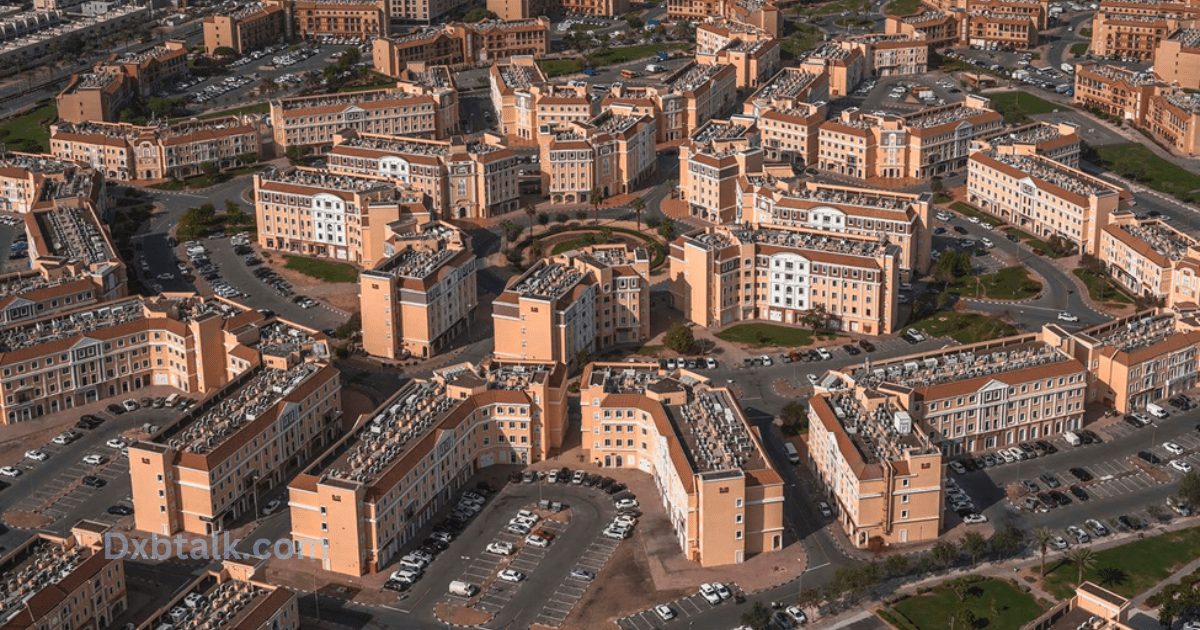
Dubai International City is one of the emirate’s most distinctive communities — a vast, themed, deliberately affordable city-within-the-city on the desert’s edge, built around an idea no other district attempted: whole clusters modelled on the architecture of other countries, housing a population as international as the theme promises. Spanning more than 800 hectares in the commonly cited figure, it is home to one of Dubai’s most diverse populations and to Dragon Mart, the retail phenomenon at its heart. This is the district explored whole — its concept, its daily life, and why it matters more than its modest rents suggest.
The Concept: Ten Countries in One District
International City was developed by Nakheel as a representation of global diversity: residential clusters themed by country — China, Persia, Greece, France, Spain, England, Morocco, Italy, Russia and Emirates among them — each dressed in its namesake’s architectural styling, from Chinese rooflines to Mediterranean facades and colours. The effect, street by street, is a gentle architectural world tour — occasionally kitsch, often charming, and entirely unlike anywhere else in the emirate. The concept was never only decorative, though. The themed clusters package a serious proposition: affordable apartments — studios and one-bedrooms predominate — at rents far below the city’s prime districts, in a master-planned setting of schools, shops and green pockets. That combination made International City the first rung on Dubai’s housing ladder for a generation of newcomers, and its clusters a genuine atlas of the city’s workforce.
Daily Life and Dragon Mart
The cultural diversity is the daily experience: Chinese tea shops and Persian bakeries, South Asian grocers and Levantine cafeterias, the prayer calls and the festival calendars of a dozen communities interleaved street by street. The food alone justifies the exploration — Chinese dumplings, Iranian kebabs, authentic biryanis, and the small restaurants where each community cooks for itself first and visitors benefit. At the district’s edge stands its crown jewel: Dragon Mart, the vast trading centre for Chinese products — over a kilometre of wholesale and retail in the commonly cited measure, thousands of stores selling everything from electronics and building materials to home décor and fashion at prices that draw trade buyers and bargain hunters from across the region. Shopping there is an expedition: allocate the day, wear the shoes, and expect to furnish something. The district connects to the rest of Dubai by the major highways at its borders — Sheikh Mohammed Bin Zayed Road above all — with bus routes tying it into the wider network.
Two practical notes complete the district. Dragon Mart deserves its own tactics: it divides into sections by trade, wholesalers and retailers share the halls, and the shopper after one item should photograph the aisle markers as they go — the place is large enough to lose a purchase in. The clusters, meanwhile, change character after dark, when the restaurants fill, the supermarkets do their busiest hour, and the streets take on the feel of a dozen hometowns at once. Visit in the evening if you can only visit once.
📸 Follow @dxbtalk1 on Instagram for daily Dubai in photos →
Who It Suits, and Why It Matters
International City is worth visiting for exactly what it is: the chance to experience the world without leaving Dubai, at prices that remind you the city has an everyday economy beneath the luxury one. For residents, it offers affordable living with a community texture the tower districts struggle to manufacture; for visitors, a gastronomic and retail expedition through the city’s real demography; for anyone trying to understand Dubai, the clearest available lesson — this is what a city of migrants builds when it houses itself. Its markets sell fresh produce, spices and local specialities; its clusters reward an evening’s wandering; its restaurants feed you around the globe in a square mile. More than a residential area, International City is a cultural tapestry that celebrates global unity by simply housing it — and in a city famous for superlatives, its quiet superlative may be the most impressive: the most international square kilometres in the Emirates.




