

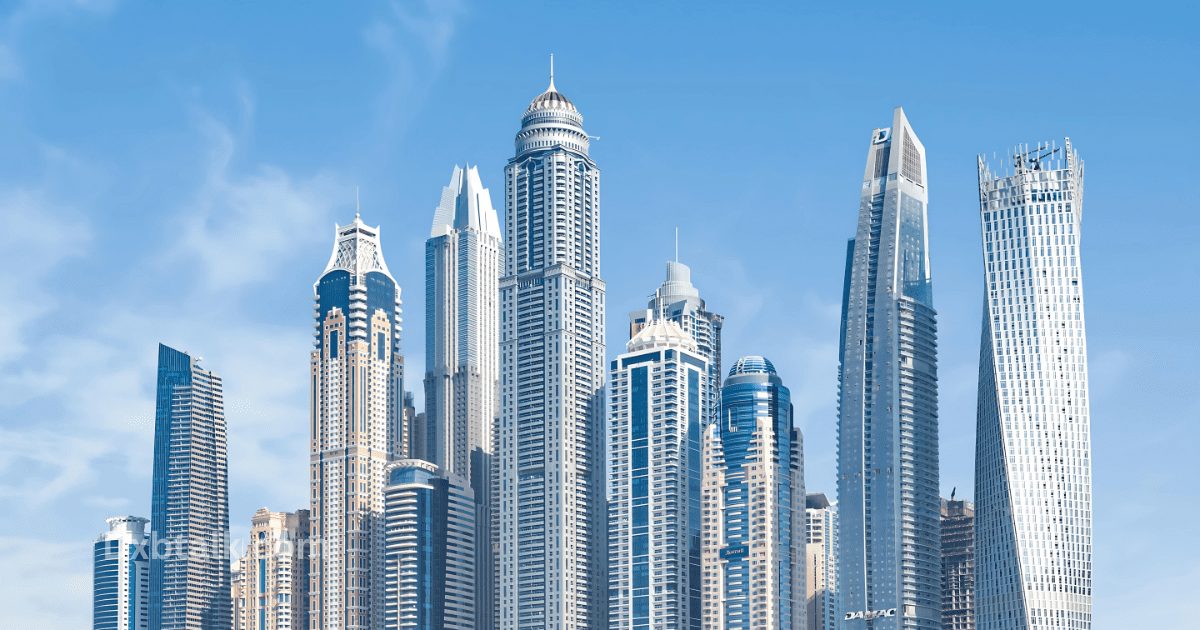
Dubai has a habit of announcing districts the way other cities announce buildings. Business Bay, launched in 2003, was among the boldest of those announcements: an entirely new downtown, cut into the desert at the head of an extended Creek, intended to give the emirate a Manhattan of its own — offices, hotels and homes arranged around water that did not yet exist. Two decades on, the district is simply there, dense and lived-in, its origin story half-forgotten. This is that story: how a line on a master plan became one of the city’s defining quarters, through a canal, a crisis and a long construction boom.
The Vision: A New Creek for a New Century
The logic began with water. Dubai’s original Creek had made the old town; the plan for Business Bay extended that waterway inland, through what would become the district, and onward until it rejoined the Gulf — creating, in effect, a new creek around which a business capital could be built. When the project was announced in 2003, the ambition was stated in superlatives: hundreds of towers, a business community on the scale of the world’s great financial districts, hotels, residences and retail woven through it rather than zoned apart. The location did the arguing — immediately south of the rising Downtown and its tower, along the Sheikh Zayed Road corridor — close enough to the old centre to inherit its gravity, empty enough to be planned whole. Plots were sold, designs commissioned, and the cranes arrived in formation.
Building Through Boom and Crisis
The first wave rose fast. Through the mid-2000s the district was one of the largest construction sites on earth: the Executive Towers among the first great completions, office and residential towers climbing together, the JW Marriott Marquis opening its twin towers in the early 2010s as — for a time — the tallest hotel in the world, a superlative the district wore as proof of arrival. Then the global financial crisis of 2008 tested the whole proposition. Across Dubai, projects stalled; in Business Bay, cranes paused over half-built plots and the district’s completion receded. What saved the story was location and the second cycle: as Dubai’s economy re-accelerated in the 2010s, Business Bay’s remaining plots were exactly where demand wanted to be, and the towers resumed — this time increasingly residential and hospitality-led, as the district quietly revised its job description from pure office quarter to something more mixed and more alive.
📸 Follow @dxbtalk1 on Instagram for daily Dubai in photos →
The Canal Changes Everything
The district’s defining moment arrived in November 2016, when the Dubai Water Canal was completed and the extended Creek finally flowed through to the sea. The engineering finished what the 2003 drawings had promised: Business Bay became waterfront. Boardwalks and cycle paths lined the banks, bridges with genuine architectural ambition crossed it, a mechanical waterfall poured beneath the Sheikh Zayed Road crossing and learned to pause for passing boats, and the water taxi and ferry routes threaded the district into the Creek’s old geography. The effect on the district’s character was immediate and permanent. A business quarter acquired an evening life; towers that had been addresses became views; the canal-side filled with runners, cafés and residents walking dogs past moored yachts. Business Bay stopped being a project description and became a place.
The District Today — and What Comes Next
The mature Business Bay is a study in mixture: headquarters and startups in the office towers, a serious hotel row along the canal, Bay Square’s low-rise courtyards doing the cafés-and-services layer, and a residential population large enough to give the district schools runs, supermarkets and rush hours of its own. The Opus, Zaha Hadid’s carved cube, gave it an architectural icon; the metro station and the Sheikh Zayed Road interchanges give it permanent connectivity to everything else. Its challenges are the honest ones of success — traffic at the peaks, the eternal pressure of demand on its roads and parking. The future is already zoned: the remaining plots fill in, the canal’s public realm extends, and the district’s second generation of buildings begins the cycle of refurbishment that marks a real city quarter rather than a development. From vision to reality took twenty years, a canal and one global crisis. Standing on the boardwalk at dusk, with the waterfall lit and the towers coming on, the original drawings look less like ambition than like a fair description — which is the rarest ending a master plan can earn.






Join the conversation