Thinking about International City? This guide looks at what living there is really like: the housing mix, how people get around, where they eat and shop, and who tends to be happiest there.
The area in short
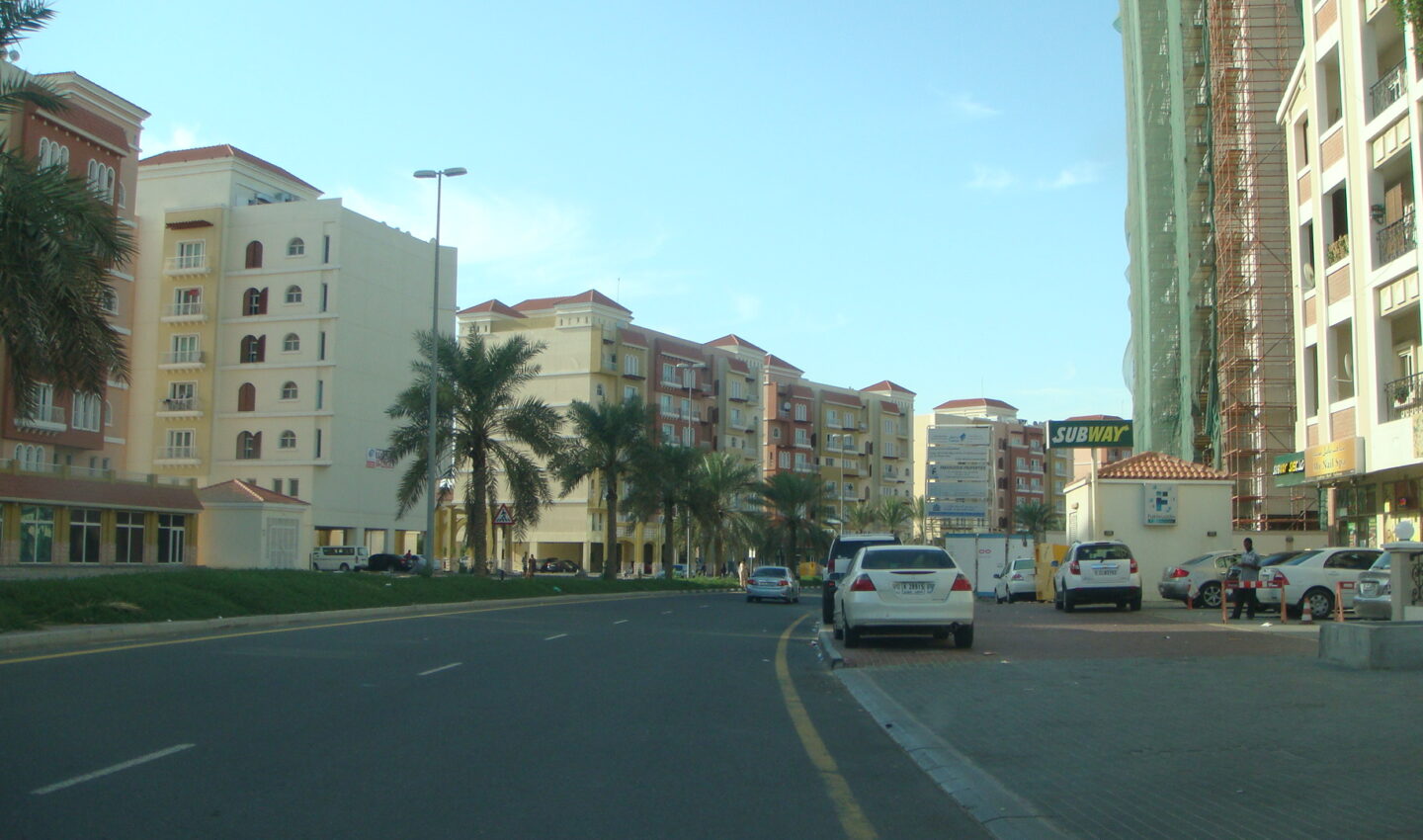
International City is Dubai’s most affordable large residential community: a Nakheel development launched in 2002 across 800 hectares in Al Warsan, in the east of the city off Sheikh Mohammed Bin Zayed Road. Its signature is the country-cluster idea — ten themed clusters named Persia, Greece, Spain, Morocco, England, France, Italy, Russia, China and the Emirates, arranged around a Central Business District — and it is home to more than 100,000 residents from well over 100 nationalities. It suits budget-conscious tenants, young professionals and small families, and traders connected to Dragon Mart.
The pros
The cheapest rents in Dubai. International City remains one of the most budget-friendly places to live in the city — studios rent from roughly AED 15,000 to AED 40,000 a year depending on the cluster and building — which makes it a common first stop for professionals and families getting established in Dubai.
Genuinely multicultural. With residents from well over 100 nationalities, the area offers a level of cultural mix that is unusual even by Dubai standards, and the country clusters give many expatriate groups a familiar corner of home.
Dragon Mart on the doorstep. Dragon Mart 1 and 2 sit immediately beside the community, with over 4,000 retail and wholesale outlets plus a Carrefour hypermarket — widely regarded as the largest trading hub for Chinese goods outside mainland China. For traders it is the reason to live here; for everyone else it is the cheapest shopping in Dubai.
Everyday life on foot. The clusters are mostly low-rise blocks with studios and one-bedroom apartments above ground-floor groceries, cafes, laundries, pharmacies and salons, so the daily errands are a short walk. Clinics and mosques sit inside the clusters, and the airport and Downtown are 15 to 20 minutes away by road outside peak hours.
📸 Follow @dxbtalk1 on Instagram for daily Dubai in photos →
The cons
No metro — and the commute is long. There is no metro station inside the community. Buses (routes 24, 66, 367 and X23) connect to the nearest station, Centrepoint — formerly Rashidiya — on the Red Line, and the Blue Line is under construction with International City stations planned and operations targeted for September 2029. Until then, a commute to the Marina, Downtown or DIFC can take 30 minutes to well over an hour at peak times.
Older, variable buildings. The stock is older and highly variable from one cluster to the next — some buildings need more maintenance than others, and the themed architecture was only partly executed, so the cluster names often matter more than any visible difference.
Services lag behind the rest of Dubai. Retail, entertainment and restaurant facilities are thinner than in most other parts of the city, there is no full-scale hospital inside the community, and schooling inside the clusters is limited — many families travel to schools in Al Warqa, Academic City or Nad Al Sheba. Paid public parking began across International City in February 2026, and parking is tight around Dragon Mart at weekends.
Getting around
Buses do the work: routes 24, 66, 367 and X23 link the clusters to Centrepoint and other metro stations, Deira, Bur Dubai and Sharjah. Taxis and ride-hailing are widely available, and the road network — Sheikh Mohammed Bin Zayed Road and Ras Al Khor Road — is functional outside peak hours, when congestion builds around Dragon Mart and the main exits.
Eating out
International City eats cheaply and widely. Each cluster has its own small restaurants and cafes at street level, Dragon Mart’s food court covers the mall end, and the Chinese restaurants around the China cluster and Dragon Mart are the area’s best-known tables. For a bigger night out, residents drive to Academic City, Dubai Silicon Oasis or central Dubai.
Who it suits
International City suits people who put low rent first — first-time Dubai residents, students, young professionals and small families — and anyone whose work ties them to Dragon Mart’s wholesale market. It suits people less well if they commute daily to the Marina, Downtown or DIFC, want a metro at the door, or expect polished buildings and full services on site. If the budget is the deciding factor, this is where Dubai is cheapest — with the commute as the price.