In 2004, Dubai did something no other city in the region had tried. On a 110-acre site beside Sheikh Zayed Road, between the old city and the new developments, it built a financial centre that would play by different rules from the rest of the country. The Dubai International Financial Centre, known as DIFC, would have its own laws, its own courts and its own regulator. International banks could come to Dubai and find a legal system they already understood.
A different kind of free zone
The DIFC was established in 2004 under Federal Decree No. 35 of 2004 and Dubai Law No. 9 of 2004. It is a financial free zone, but it is not like the other free zones around the port or the airport. Its civil and commercial laws are based on English common law, and UAE federal civil and commercial law does not apply inside it. Disputes are heard by the DIFC Courts, an independent, English-language common law court system.
Financial services inside the centre are regulated by the Dubai Financial Services Authority, the DFSA, an independent regulator. The centre itself is managed by the DIFC Authority. That three-part structure, laws, courts and regulator, was the point of the whole project: to give the world’s financial firms a familiar, trusted legal home in the middle of the Gulf.
The Gate
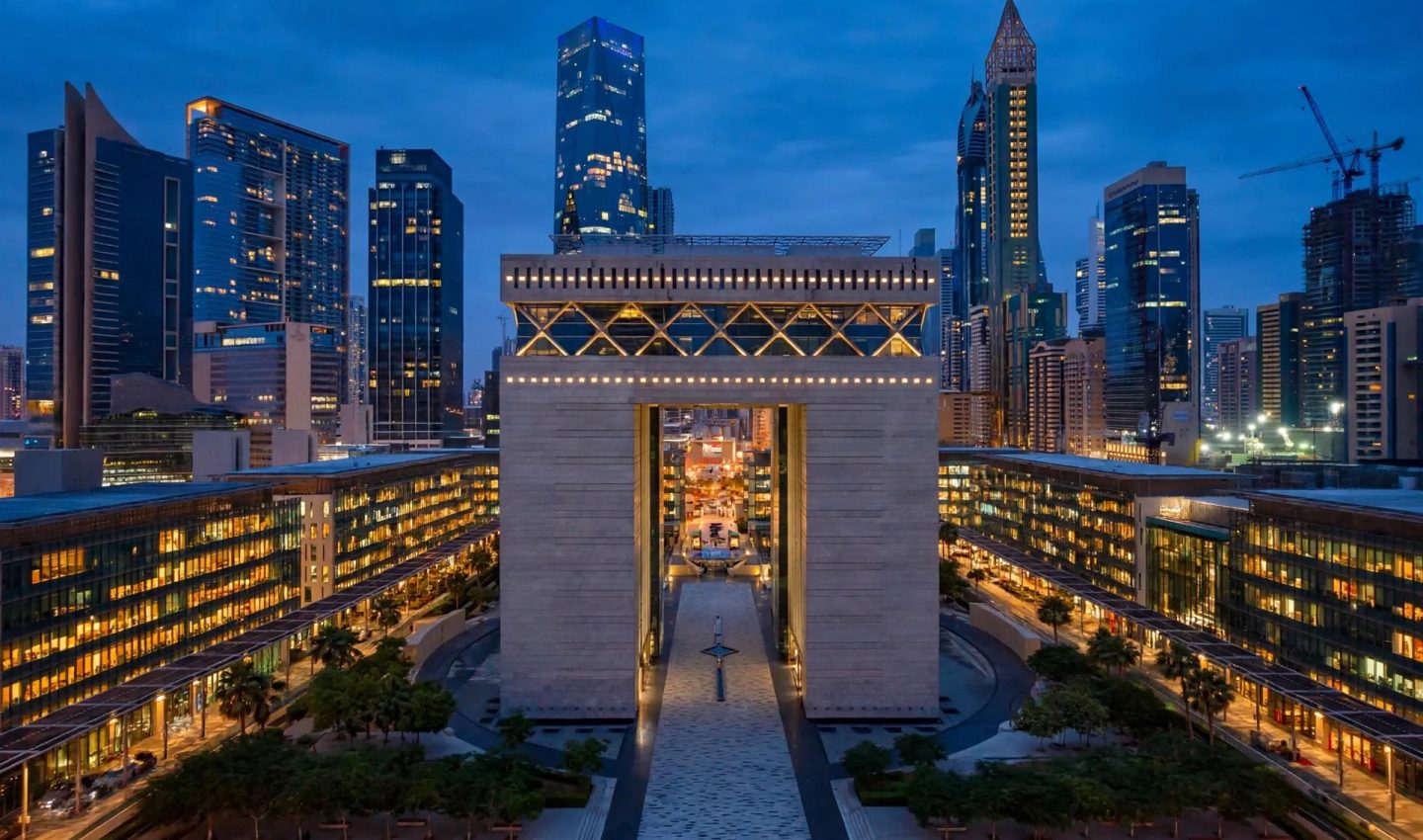
The physical symbol of the DIFC is the Gate, the landmark building that stands at its entrance like a great stone arch over the district. Around it grew the Gate District, with its towers, its offices and its restaurants, and Gate Village, the arts district that houses some of the region’s leading contemporary art galleries. The DIFC was designed from the start to be more than offices: a place where bankers, lawyers and artists would share the same streets.
For years the district grew steadily, and then, in the middle of the 2020s, it accelerated. By the end of 2025 it had 8,844 active companies. Then, in the first half of 2026, it passed 10,000 active registered companies for the first time: 10,018 at the end of June 2026, up 30 per cent year on year, according to the DIFC’s own figures. Within that total were 1,134 regulated financial services firms, including hundreds of banks, wealth and asset managers and insurers.
Free Dubai Tools
Dubai, in Your Hands
📸 Follow @dxbtalk1 on Instagram for daily Dubai in photos →
A city within the city
Today the DIFC is home to 27 of the world’s 29 global systemically important banks, and to more than 50,000 professionals. Its family-wealth cluster has grown to more than 1,400 family-related entities. Its governor is Essa Kazim, who also chairs DP World, linking the city’s financial centre to its ports.
What the DIFC really built was trust. A bank in London or New York could open an office in Dubai and know exactly which laws applied, which courts would hear a dispute, and which regulator would watch over it. That trust is why the world’s biggest financial firms came, and why they stayed. The buildings are impressive, but the laws are the real construction.
How It Was Built — the city, piece by piece.
DXB FACT — DID YOU KNOW?
The largest harbour humans ever built
- Jebel Ali recordworld's largest man-made harbour
- Containers in 202415.5 million TEU
- Middle East rankNo. 1 container port
- Opened1979
Source: DP World
A new Dubai fact every dayRead more »
Reader poll
Poll of the Day
A fun reader poll, just for curiosity — not an official survey. A new question arrives every day.