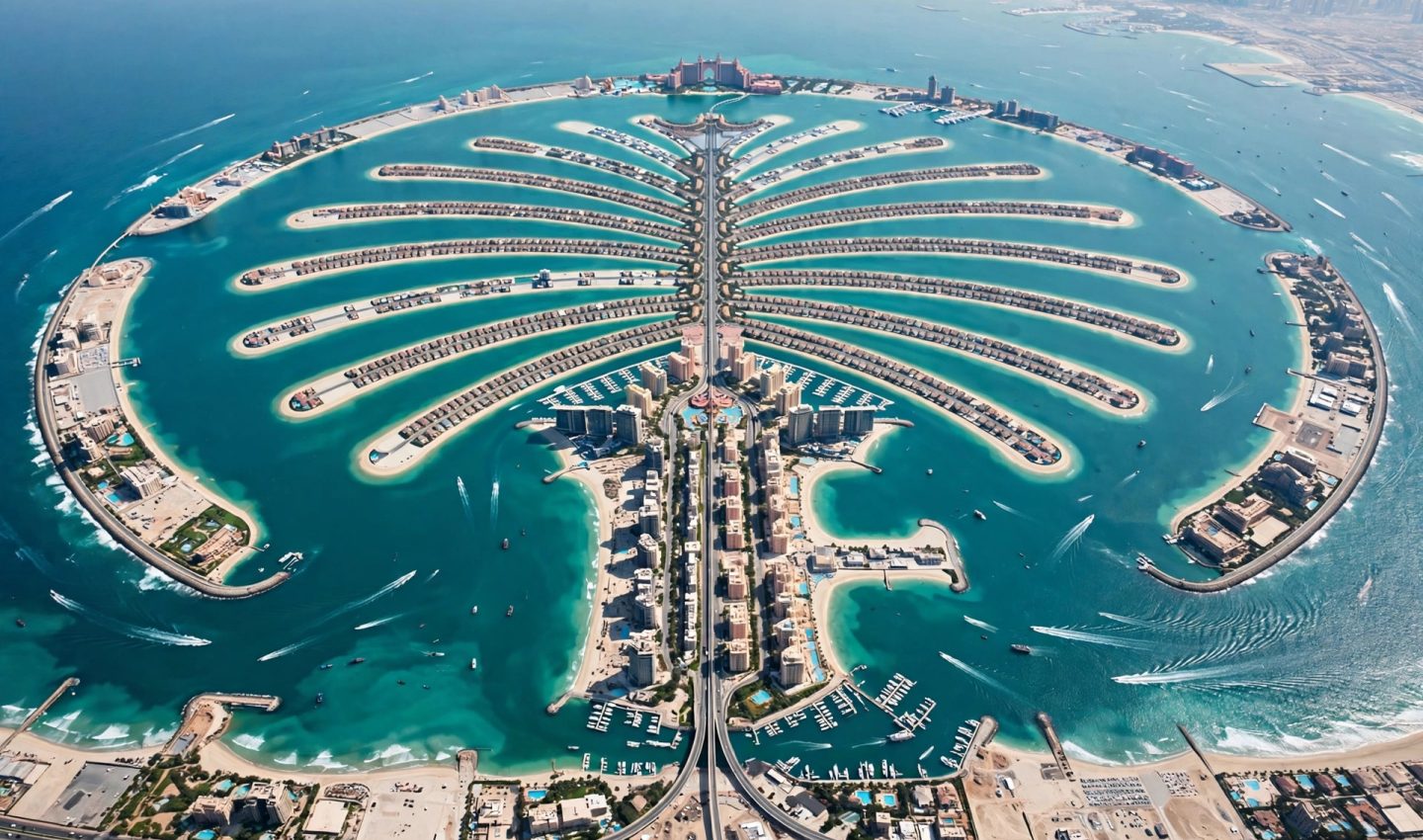
In 2001, the dredgers arrived off the coast of Dubai and began doing something no one had done at this scale before: building an island in the shape of a palm tree, big enough to be seen from space. The Palm Jumeirah — 5 kilometres long, 5 kilometres wide — added 78 kilometres of new coastline to Dubai, and it was built from nothing but sand and rock.
The developer was Nakheel, and the method was as simple as it was enormous. Dredgers sucked sand from the seabed and sprayed it into place in a technique called rainbowing — arcs of sand falling like rain to form the trunk, the fronds and the crescent breakwater. In total, the island used around 94 million cubic metres of sand and 7 million tonnes of rock. No concrete or steel holds it together: the sand was vibrated into place until it compacted into solid ground.
Building a palm shape in the sea was a navigation problem as much as an engineering one. The island’s shape had to be laid out with GPS-guided precision, because a frond a few metres out of place would show up in every aerial photograph. Divers and surveyors worked in shifts, and the crescent breakwater was armoured with rock to break the Gulf’s waves before they could reach the villas.
The first residents moved in during 2006, and Atlantis, The Palm opened on the crescent in September 2008 with a fireworks display that lit up the whole island. The Palm became Dubai’s most famous address — villas along the fronds, hotels along the crescent, and the monorail running down the trunk.
Today the Palm Jumeirah is home to tens of thousands of residents and some of the city’s best-known hotels and restaurants. It also proved a point that Dubai has repeated ever since: the city’s map is not fixed. When Dubai runs out of coastline, it builds more.
Free Dubai Tools
Dubai, in Your Hands
For a city that builds big, the Palm is the boldest proof of all: an island drawn on a map, then poured into the sea — sand by sand, until a palm tree floated off the coast of Dubai.
The Palm also taught Dubai’s engineers how to build in the sea. The techniques perfected here — rainbowing sand, vibro-compaction, rock breakwaters — were reused on the Palm Jebel Ali and the World Islands, and the survey data from the Palm’s construction is still studied by coastal engineers around the world. An island built for villas became a classroom for an entire industry.
Part of How It Was Built — DXB Talk’s series on the making of Dubai’s landmarks.
DXB FACT — DID YOU KNOW?
The biggest picture frame on Earth
- Dubai Frame height150.23 m
- Width95.53 m
- Recordlargest frame-shaped building
- OpenedJanuary 2018
Source: Guinness World Records
A new Dubai fact every dayRead more »
Reader poll
Poll of the Day
A fun reader poll, just for curiosity — not an official survey. A new question arrives every day.