

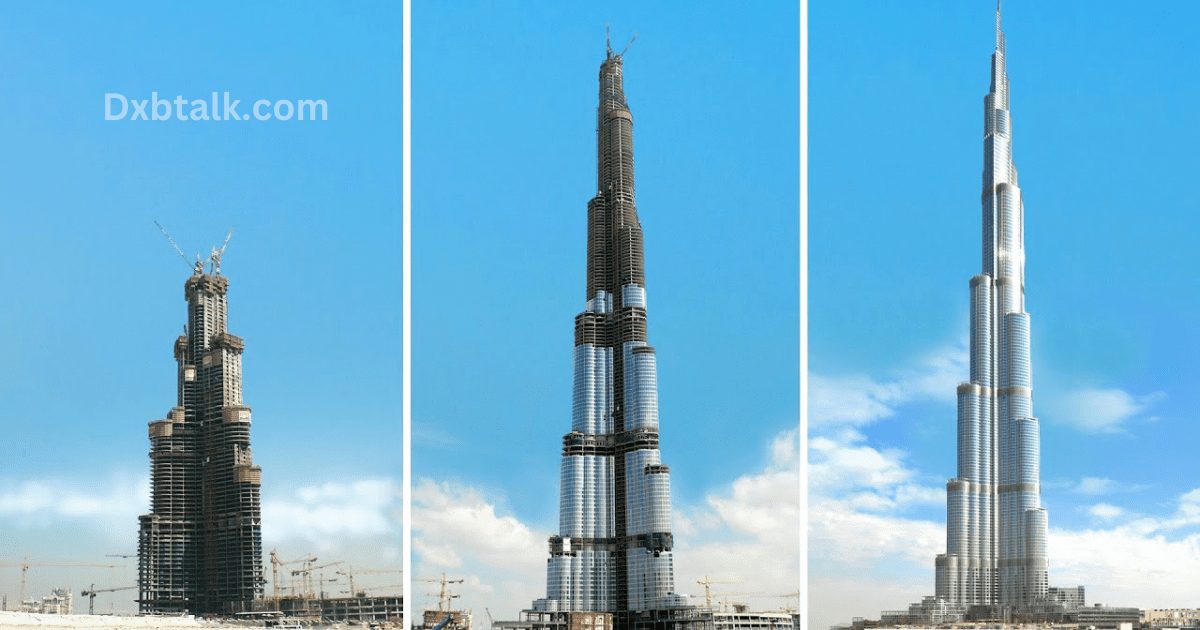
Some buildings are addresses. The Burj Khalifa is a unit of measurement — the one against which Dubai, and then the world, learned to measure height itself. At 828 metres, it is not the tallest building by a little; it cleared the previous record by a margin so large that its architects kept the final height secret during construction, in case a rival dared to aim at it. Yet the tower’s real achievement is not the number. It is that a structure this extreme became, within a decade, a beloved piece of a city’s furniture — the thing residents navigate by, celebrate under, and point at when words run out. This is its story, and the way to experience it.
Building the Impossible: 2004 to 2010
Construction began in 2004, on a site at the heart of the new Downtown development, with Emaar’s brief essentially unbounded: build the world’s tallest structure, as the centrepiece of a new city district. The architect was Adrian Smith, then of Skidmore, Owings & Merrill, and his design reached for its solution in two directions at once — to Islamic architecture, in the spiralling geometry of the region’s minarets, and to nature, in the Hymenocallis, a desert flower whose three-petal structure gave the tower its tri-lobed footprint. The tower rose through the boom and the financial crisis alike, its height concealed inside the plan until late in the climb, and opened on 4 January 2010 — renamed, in a gesture that caught even the ceremony’s audience by surprise, for Sheikh Khalifa bin Zayed Al Nahyan, the UAE’s president. Dubai had its exclamation point.
The Engineering of 828 Metres
Height at this scale is a negotiation with physics, and the Burj’s answers became the textbook. The buttressed core — a central hexagonal core braced by the three lobes of the footprint, each stepping back in a spiral as the tower climbs — gives the structure its stiffness and confuses the wind, which sheds its force around the ever-changing profile instead of organising the vortices that sway lesser towers. The numbers still startle: 163 floors above ground, more than 330,000 cubic metres of concrete, tens of thousands of tonnes of steel, a cladding of reflective glass and aluminium panels individually able to flex with the desert’s temperature swings. The lifts are destinations in themselves — among the fastest on earth at around ten metres a second, in double-decker cabins. Even the water system had to be rethought: at this height, a building is a small city’s worth of plumbing stacked vertically against gravity.
📸 Follow @dxbtalk1 on Instagram for daily Dubai in photos →
Experiencing the Tower
The visitor’s Burj begins at At The Top, the observation experience on levels 124 and 125 — reached, memorably, by a travelator through the tower’s own story and then by that lift, whose minute-long climb your ears will register. The deck offers the complete geography lesson: the coastline and the Palm, the canal and the Creek, the old town at the water’s edge and the desert running out to a horizon that curves. Above it, At The Top SKY on level 148 — for years the highest observation deck in the world — adds the lounge version: fewer people, higher glass, a guide’s narration. Around these anchors, the tower offers its other altitudes: At.mosphere, the fine-dining restaurant on level 122, still among the highest places on earth to sit down to dinner; the Armani Hotel occupying the lower floors with the tower’s own minimalist hospitality; and at the base, the Dubai Fountain performing on the lake the tower overlooks, which is how most evenings in its company properly end — watching the water dance to the building’s scale. Book the observation decks ahead, favour sunrise slots or the hour across sunset, and check in with time to spare: this is the one appointment in Dubai that half the world is also keeping.
The Tower in the City’s Life
What no rendering predicted was the affection. The Burj became Dubai’s clock tower and Christmas tree in one: its LED skin carries the New Year countdown and the national celebrations, its silhouette signs the weather — visible, residents swear, from ninety kilometres — and its image anchors everything from the marathon’s photographs to the fog mornings when the tower stands above a sea of cloud with only its own top floors in the sun. Pilots navigate by it; taxi drivers orient by it; children draw the city’s skyline as one line and this tower. Records, the engineers will tell you, are temporary by definition, and someday a taller structure will take the title the way the Burj took it from Taipei 101. When that day comes, the Burj Khalifa will keep the thing it actually won in 2010 — not the record, but the role: the building a young city chose to introduce itself with, and grew, in every sense, to fill.






Join the conversation